ROCKABILLY HALL OF FAME® MERCHANDISE & SERVICES
A ROCKABILLY HALL OF FAME EXCLUSIVE:

News Archive #1
WSM-AM: Country Radio
Station of the Century
NASHVILLE, TN, March 8, 2000 -- Radio station WSM-AM, the first component of today's Gaylord
Entertainment Company and the home of the Grand Ole Opry since 1925, has been named "Country
Station of the Century" by Radio & Records, a leading broadcasting industry trade publication.
The tribute to WSM-AM is part of a Radio & Records special section, "A Century of Country," that spotlights several
aspects of the country radio industry, including the naming of country's greatest personalities, artists, executives and
programmers. The special section is in the March 3 issue.
Radio & Records surveyed country radio industry veterans who have a national perspective on broadcasting plus more
than 20 years' experience. That panel identified the people and organizations that have been leaders in country radio.
"A truly great radio station combines time, people, ratings and leadership in establishing a legacy. Our voters gave the
overall nod to the broadcasting home of the Grand Ole Opry--the "Mother Church" of country
music--WSM-AM/Nashville," the editors said as they identified WSM as the "Country Station of the Century."
WSM-AM went on the air in 1925 as a service of the National Life and Accident Insurance Company. Its call letters were
an acronym for the company's motto, "We Shield Millions."
The year the station started broadcasting, program director George D. Hay started a live country music show called the
"WSM Barn Dance." An ad-lib from Hay about two years later changed the name of the show to the Grand Ole Opry, and
that began the process that transformed Nashville into Music City USA. (It was another WSM personality, David Cobb,
who coined the Music City USA nickname for Nashville.)
"Everyone who works at WSM-AM understands the legacy of 75 years of broadcasting. We are both pleased and humbled
to be recognized by our peers nationally for what the station has accomplished. Our pledge to our listeners and to
country music is to continue that tradition," said vice president and general manager Bob Meyer.
For decades, WSM's impact has reached far beyond Nashville because of its 50,000-watt clear channel signal. That
signal, beamed from the station's diamond-shaped tower, can reach listeners across much of the U.S. and into Canada
and Mexico.
Also, former WSM on-air personality Ralph Emery was identified as the "top jock" in the history of country radio in the
same Radio & Records section. Emery gained fame in the 1960s as host of WSM's overnight "Opry Star Spotlight" show
before gaining even wider fame as host of a syndicated country radio show and host of The Nashville Network's
"Nashville Now" show on cable TV.

Frank "Pee Wee" King Dies
By THOMAS S. WATSON - Frank "Pee
Wee" King, who co-wrote the "Tennessee Waltz" and helped bring an eclectic mix of instruments
and musical styles to the Grand Ole Opry, died Tuesday at age 86.
King had been hospitalized after suffering a heart attack Feb. 28.
Born Julius Frank Anthony Kuczynski in Abrams, Wis., King wrote "Tennessee Waltz" with
fellow band member Redd Stewart in 1947. The two said they wrote it on an unfolded matchbox
as they were riding in Stewart's truck.
While King's recording did well, a version of the song by Patti Page became a No. 1 pop hit and
sold 65 million copies. It became the state song of Tennessee in 1965.
King joined the Grand Ole Opry in 1937. During his 10-year run on the popular country music
radio show, he was among the first to do polkas, cowboy songs and waltzes, as well as use
trumpets, drums and electric guitar in his band. King's Golden West Cowboys were outfitted in
colorful western outfits designed by the Hollywood tailor Nudie, a look other stars emulated.
Future stars like Eddy Arnold, Cowboy Copas and Ernest Tubb played in King's band.
In 1974, he was inducted into the Country Music Hall of Fame.
"I learned a lot about showmanship from him," said Arnold, who played guitar with Golden West
Cowboys in the 1940s.
King and the band appeared in several of Gene Autry's movies. They also appeared in Westerns
with Charles Starret, the Durango Kid, and Johnny Mack Brown.
Charlie Gracie Update


LEFT: Charlie recently opened for Van Morrison, doing seven shows in
Los Angeles, Reno and Las Vegas.
RIGHT: Charlie pictured with Paul
McCartney. Paul performed Charlie's hit recording "Fabulous" on his new CD.
Scotty Moore,
the Guitarist Behind The King
(Courtesy The Dallas Observer, March 1, 2000 by Michael Roberts )
The complaint most frequently levied against Cleveland's Rock and Roll
Hall of Fame and Museum is a conceptual one. Putting up a
tourist-friendly, mainstream memorial to what began as anti-establishment
music, critics of the Hall say, is the best possible way to snuff out any
sense of danger the form might still possess (emphasis on might). After
all, museums are for dead things, not living ones.
When he's presented with this argument, Scotty Moore, who will be
inducted into the Hall of Fame in the brand-new "sidemen" category during
a March 6 ceremony at New York City's Waldorf Astoria Hotel, emits a
good-natured chuckle. "I hadn't really thought about it as a museum, but
I guess that's right," he says, in a soft tone marked by a pleasant
twang. "I'll try not to move when people pass by me."
This self-deprecating remark is characteristic of the man. As the
string-strangler behind most of Elvis Presley's best work, Moore, who's
in his late 60s, helped shape the sounds of the last half-century. But in
conversation, he refuses to overdramatize himself or his contributions to
the music for which he's being feted. Despite the Hall of Fame spotlight
currently shining on him and the other inaugural sideman honorees
(saxophonist King Curtis and bassist James Jamerson, both deceased, plus
drummers Earl Palmer and Hal Blaine), he prefers sticking to the shadows,
just as he did when he was on stage with Presley, figuratively putting
himself in the background of his own story out of force of habit.
That's not all bad, of course: Moore's modesty is a welcome alternative
to the worshipful pap regularly churned out by the Rock and Roll Myth
Machine. And modest he is. He makes it clear that the title of The Guitar
That Changed the World!, his 1964 solo album, most certainly wasn't his
idea, and he seems dumbfounded to learn that Presley was recently named
the 57th most significant figure of the last millennium in a program
aired on the Arts & Entertainment network. "There's no question he
touched a lot of people," Moore concedes. "But a thousand years is a
loooong time."
On top of that, he had to be cajoled into participating in That's
Alright, Elvis: The Untold Story of Elvis's First Guitarist and Manager,
Scotty Moore, a tome he co-wrote with Jim Dickerson that was published in
1998. According to him, "There were just so many books out there that I
couldn't see getting into the fray, so to speak. And I thought that
everything had been told. But I have a daughter in Memphis who knew Jim,
and she was constantly saying, 'Why don't you do something? Why don't you
do something?' over several years. So finally I just said, 'If you'll
hush, I'll do it. Now, leave me alone.'"
Moore's account of the July 1954 night when he, Elvis, and bassist Bill
Black recorded the Arthur Crudup blues "That's All Right (Mama)" for
producer Sam Phillips at Sun Studios in Memphis is similarly low-key.
Many rock historians regard this session to be the genre's single most
important event, a seismic experience that permanently altered the
pop-music landscape even as its mixing of black and white influences
prefigured the civil rights movement. But Moore sees the evening in much
simpler terms.
"I did an interview with this fella in Amsterdam," he notes, "and he
said, 'What did you think of the big bang?' And I said, 'What? What big
bang?' And he said, 'You know. The big bang -- when Elvis cut 'That's All
Right.'" After a hearty laugh, he clarifies things: "That wasn't the big
bang. That was an audition."
Elvis passed, as it turns out. But Moore, a native of Gadsden, Tennessee,
who got to know Phillips through the Starlite Wranglers, a band he'd
helped form after his discharge from the Navy a couple of years earlier,
still has a hard time making the moment seem magical. "We did what we
were supposed to do, the three of us," he says. "We played a lot of
rhythm, and I was trying to throw in some side notes in there, to make it
kind of fuller. So I guess we knew it was a little different than the
other things we'd been doing. But we didn't have any idea that it was
going to be anything special.
"It was radio that made the difference," he goes on. "This disc jockey
[Dewey Phillips, no relation to Sam] started playing the thing, and he
just played it over and over and over and over. It was almost like he got
the people in the audience kind of brainwashed by it. But even then, it
wasn't like anything happened overnight. We had to pay our dues for about
a year and a half. It wasn't until we did our first TV show, with the
Dorsey Brothers, that we realized, you know, we'd better hang on."
Prior to the rocket taking off, Moore had managed Presley and his band,
collectively known as the Blue Moon Boys. These duties were later taken
on by Bob Neal and, more famously, Colonel Tom Parker, leaving Moore time
to concentrate on playing. Along with drummer D.J. Fontana, the first
addition to the lineup, and bassist Black, who died of a brain tumor in
1965, he backed Presley on the hits that established his legacy:
"Heartbreak Hotel," "Baby, Let's Play House," "Blue Suede Shoes,"
"Jailhouse Rock" and so on. But while Moore's clean, energetic riffing
and power-glide solos have plenty to do with the tunes' success, he never
forgot that he was there to support the singer, not overwhelm him.
"I tried to keep it simple -- and simplicity, you know, that's something
you have to work at. I listen to some of the things now and I think, I
could have played a lot more stuff there. But I'm glad I didn't. Like on
'Don't Be Cruel': I played the little intro on that and played a chord on
the very end, and that's all I played during the whole song. But it
didn't need anything else. That little rhythm thing Elvis was doing on
his guitar and D.J. and the Jordanaires [a vocal quartet often used by
Presley] doing that little doo-wop thing...Well, it just fell right in a
groove, and I figured, maybe we'd better leave well enough alone.
"Sometimes it took quite a while to get it right," he continues, "and the
studio people would fuss at us. They'd go, 'Buncha damn amateurs.' But we
were constantly trying to find things that we thought would fit the song
and not get in the way of the vocal. Besides, it didn't take me long to
play every note I knew" -- another laugh -- "so I just wanted to put them
to good use."
Presley's 1958 induction into the Army didn't end Moore's interactions
with the King; he worked on numerous '60s tracks and was a key
participant in Elvis' 1968 television special, which saved a career
nearly done in by lousy, interchangeable movies and the mainly crummy
soundtracks that went along with them. But Moore was involved in other
projects as well. He founded his own label, Fernwood Records, which
spawned one decent-sized hit (Thomas Wayne's "Tragedy"), and worked for
Sam Phillips as engineer and head of production at Sun. (He was involved
in the creation of some intriguing and underappreciated work by Charlie
Rich, for instance.) And then there was the Epic Records release The
Guitar That Changed the World!, an effort that teamed Moore with Presley
cohorts Fontana and the Jordanaires, plus studio regulars such as
saxophonist Boots Randolph, under the supervision of Nashville
super-producer Billy Sherrill.
"It was supposed to be one of a series," Moore remembers. "Billy sold CBS
[Epic's owner] on the idea that we could do a lot of the Elvis stuff --
volume one, volume two -- and put them in chronological order. And CBS
said, 'That's a good idea.' But when it got down to doing the session,
they said, 'Maybe you ought to just do some of the bigger hits today, and
we'll kind of test it.' And when they did, that was the end of that
project.
"I know they must have sold quite a few of them, because D.J. and I play
Europe every once in a while, and nearly every show, somebody comes up
with a copy and wants us to sign it. But the funny thing is, Sony owns
Epic and CBS and all that now, and every so often, I still get statements
in the mail from them telling me I still owe about $2,500 in production
costs on that." Lightheartedly, he adds, "When it's about money, they
never forget."
Of course, Moore has his gripes about remuneration too. He doesn't mind
that he makes no money from the continued sales of Presley's familiar
songs; he was paid for playing on them, and that's that, as far as he's
concerned. But he feels differently about the issuing of previously
unheard takes on platters such as Sunrise, put out by RCA, Presley's
longtime label, in 1999. Thanks to a complicated set of accounting
gyrations, RCA has been able to shrink what it owes Moore to practically
nothing. For Sunrise, he says, he's received a single check for $42.25.
Nonetheless, he has no plans to initiate any lawsuits over such
practices. "Things'd get too nasty. It'd be too big a fight. But there'd
be some fur flying if Elvis was still alive."
News flash: He's not. (He died in a Graceland bathroom in 1977.) Moore,
who last played with Elvis around the time of the '68 TV special, watched
Presley's demise from a distance, saddened by his deteriorating physical
condition and unimpressed by much of the music. "I think the stuff in the
'70s was a little overproduced," he says, "and I don't know if it was as
good as his first things. You know, when D.J. and I play, we never get a
request for anything pretty much out of the '50s. But when Elvis would do
those songs later, he'd just throw them away in medleys -- do them really
fast, like, 'I hate to have to do this.' And that would always bug me."
Not that Moore was one of those with Elvis connections who dogpiled on
Presley's corpse before it had cooled. He pretty much kept to himself
while others cashed in, focusing on two businesses: a tape-duplication
facility and a printing shop. But he did pitch in as a consultant to
Elvis, a short-lived early-'90s television series that depicted Presley
during his nascent stage. Scotty was portrayed by actor Jesse Dabson,
with whom he's still friendly: "He's been doing these Southern Bell
commercials the last two, three years," he says with paternal pride. But
while most reviewers back then were pleasantly surprised by the program's
aura of verisimilitude, Moore knew better.
"All the writers would call me up on the phone," he says, "but when I
would get a rough script, invariably whatever they called to talk to me
about wouldn't have nothin' to do with it. I wouldn't even recognize it.
They'd always get just enough truth in there to make it believable, and I
understood they had to stretch. But it should have been an hour long
instead of thirty minutes, and I think deep down they wanted it to be
like The Dukes of Hazzard. They'd want Elvis and Bill and me to stop and
get gas at a service station, and the place would get robbed, and we'd be
involved in some kind of chase or something -- and I hate to tell you,
but that never happened. And they always wanted to make Bill look like
the heavy in the whole thing. Now, Bill did have a short fuse, but they'd
have him taking his bass and walking back to the next town, quitting or
several other things like that. And that was just ridiculous."
The failure of Elvis didn't bother Moore much, but when his businesses
went south, he was left with time on his hands. He filled it in 1997 with
his first recording project in ages: All the King's Men, credited to him
and Fontana. The disc, issued by Sweetfish Records, included guest
appearances by a wide array of artists eager to pay homage to two such
important figures, including the Mavericks, the Bodeans, Cheap Trick,
Tracy Nelson, Joe Louis Walker, Joe Ely, and Steve Earle. But the biggest
names on hand were a pair of Rolling Stones: Ron Wood, who paired with
Jeff Beck on "Unsung Heroes," and Keith Richards, the star of "Deuce and
a Quarter." The CD was so well-received that Moore and Fontana are
contemplating a follow-up to feature performers who expressed interest in
participating on the first platter but couldn't because of scheduling
difficulties.
"Bonnie Raitt was going to do it, and Chris Isaak," he says. "And there
was a funny little story about Mick Jagger. We were at Ron Wood's studio
in Ireland with Jeff Beck, and the phone rings, and it's Mick. He asks,
'What are you doing?' And when Ron says 'We're recording with Scotty and
D.J.,' he gets us on the phone and goes, 'Well, why didn't you ask me?'
And we were like, 'We already got two of you. We didn't want to push it.'
Then, when I saw him later, I asked, 'If we do another one, are you up
for it?' And he told us, 'I want to be the first one you call.'"
Meanwhile, the Hall of Fame beckons. Moore admits to mixed emotions over
his admission. "The problem to me is, Bill Black, myself, and Elvis were
a group, the Blue Moon Boys. We should have all gone in as a group. But I
know there's a lot of politics in that kind of thing, and with this new
category, I'm happy that it's opening up for so many other deserving guys
down the road.
"The time's probably right," he says with a snicker. "I'm gettin' up
there. I suppose I'm just about ready for a museum now."
More on Scotty Moore ...
THE COMMERCIAL APPEAL HEADLINE:
"'SIDE-MAN' MOORE ALWAYS IN THE MIDDLE OF THINGS"
Date: SATURDAY, March 4, 2000 -
One thing is certain. Scotty Moore wasn't inducted into the Rock and Roll Hall of Fame because of Boobs a Lot.
Yes, the infamous Holy Modal Rounders tune and Dr. Demento favorite was engineered by Moore, but it's his other achievement - as Elvis Presley's indispensable, guitar-playing partner in the birth of rock and roll - that has finally put him in the Cleveland, Ohio, museum's pantheon.
Moore was one of the five inductees in the new "Side-men" category. Saxophonist King Curtis (the Coasters, Aretha Franklin, Memphis Soul Stew), Motown bassist James Jamerson, New Orleans drummer Earl Palmer (Little Richard, Fats Domino) and drummer Hal Blaine (Phil Spector records) are also in the first roll call.
It's been a long time coming for Moore, 68, who should have been lauded alongside Presley at the inaugural 1986 induction. So, too, should have Elvis bassist Bill Black and drummer D. J. Fontana. It was a band after all.
Speaking from Nashville, Moore says he has mixed emotions about the honor.
"It makes you feel good," he says. "(But) we should have all went in as a group. It was the Blue Moon Boys. And that kind of irritates me. Bill and D. J. are not in there yet."
Still, recognition is better late than never. The sidemen/sessionmen ranking itself - argued for in 1995 by Larry Nager, former writer for The Commercial Appeal - is an important step by the Hall of Fame to recognize the many musicians who didn't back the hits so much as make them (a whole slew of Sun, Stax, Hi and American Sound Studio players are waiting in the wings, guys).
Moore says that, although he doesn't mind being in such a category, the term "sideman" bothers him personally since that wasn't his role with Presley. Sidemen don't have signature tunes, after all, and the guitar workout Mystery Train is unqualifiedly Moore's.
"A sideman is somebody who can jump up there and play with just anybody," he says. "We got accused for wasting time and not being talented enough to do things. But we didn't want to play a bunch of notes and go on to the next song. We tried our best to do something we thought would fit."
If John Lennon's statement applies that "Before there was Elvis, there was nothing," then it equally fits Moore and all rock guitarists who have had to follow his culture-blazing trail. Don't take my word for it.
"The parts that I haven't stolen from James Burton, I've probably stolen from Scotty Moore," said John Fogerty last year in The Commercial Appeal.
Or try this quip from Rolling Stones guitarist Keith Richards, found in Moore's autobiography with James Dickerson, That's Alright, Elvis: "Everyone else wanted to be Elvis. I wanted to be Scotty."
Moore's style really had no precedent. His sophisticated yet economical use of the fretboard, combined with alternating flat and finger-picking techniques, may have drawn from jazz and blues, but how it was put to use - on Sun classics such as That's All Right, Good Rockin' Tonight and Mystery Train - was something utterly new.
"I loved some of the stuff Chet (Atkins) would play, thumb and finger stuff, but I also loved stuff by jazz players Tal Farlow and all these guys. I'd hear a little note or two and try to make it all fit together."
In fact, the way Moore played became a running joke between him and Sun owner/producer Sam Phillips.
"I was trying to make more noise playing the rhythm things, just jabbing in notes and stuff," says Moore. "And he (Phillips) would say, `Don't try to play that Chet Atkins stuff.' And I'd say, `Well, hire some more damn musicians then!' "
Compared to Presley's history, Moore's is less known. His first professional band was Doug Poindexter & the Starlite Wranglers, a sextet that also included Bill Black. They made one single in 1954 for Sun, My Kind of Carryin' On.
"There wasn't any groups around, it was just all pick-up bands," says Moore of Memphis in the early '50s. "I could go out and book something, start calling around and might end up with a bassoon or a tuba, no telling what. It didn't matter as long as you played the music. That's when I decided I wanted to get a bunch of guys that would stay together. That's how the Starlight Wranglers came about."
It didn't last long, though. Mere months after the single came out, Moore invited Presley to his apartment where an informal audition with Bill Black was held. The next night, July 5, the trio cut loose during a rehearsal break and Phillips captured the history-making moment: That's All Right.
So what was it about Moore and Black that made Phillips initially pair them with Presley?
"Free," laughs Moore. "We were all hungry looking. We didn't go in to cut a record. . . . Bill was working at Firestone building tires and I was working for my brother's cleaning plant blocking hats."
In the meteoric first years of Presley's rise to fame, the Blue Moon Boys Moore and Black felt increasingly pushed out of the picture, especially once Col. Tom Parker came on board as manager (Moore managed Presley for the first six months followed for a short time by WMPS disc jockey Bob Neal).
Louisiana Hayride drummer D. J. Fontana joined in 1955 and soon after, Moore and Black were put on a weekly salary of $200 when working, $100 when not, according to Moore's book. In the fall of 1957, with money issues still unresolved, the two performers resigned from the act. They returned a month later but Presley's draft notice that December silenced the original group for good.
Black formed his own combo and had many instrumental hits for Hi Records including 1960's Smokie (Part 2). He died of a brain tumor in 1965.
Moore went into engineering and producing. A stint at Fernwood Records yielded the 1959 Thomas Wayne hit Tragedy. Moore also made records for Sam Phillips, notably the juke classic "Hey Boss Man!" by bluesman Frank Frost (who also paired with Moore for a mid-'60s session on Jewel).
Moore didn't stop playing. He appeared on several Chess sessions by Dale Hawkins and the Moonglows and made his own solo album, the 1964 LP "The Guitar That Changed the World," with producer Billy Sherrill. Moore reunited as well with a post-Army Presley and played on many of his '60s sessions, including a final gig with the King, the televised '68 Comeback special.
But it was recording that beckoned Moore most. And with his own studio, Music City Recorders, that was what he concentrated on after moving to Nashville in 1964.
"From day one, I was always interested in that side of it, more engineering than I was producing," says Moore. "At RCA . . . so many times I'd go in a control room and it didn't sound anything like what I was hearing out on the floor. And that's what became a challenge to me - making it sound as close to what they were doing out there, not what I thought it ought to sound like."
Moore engineered many records, including 1969's "Make a Joyful Noise" by Tracy Nelson's group Mother Earth, and Ringo Starr's 1970 effort "Beaucoups of Blues." He even ventured into the tape copying and printing business. The one thing he forgot to do for nearly 25 years was pick up his guitar. After the '68 Comeback appearance, Moore rarely tuned up and plugged in.
That all changed when Carl Perkins convinced Moore to collaborate on the 1992 album, "706 Reunion: A Sentimental Journey."
Since then, Moore has comfortably returned to a musician's life.
He appeared at The Pyramid's 1994 Elvis tribute and in 1997 - the same year his autobiography came out - played in the interactive Elvis show at the Mid-South Coliseum and made an album with D. J. Fontana, "All the King's Men," that featured such high-profile guests as Keith Richards, Jeff Beck, Ron Wood, the Band, and Cheap Trick.
The next year, he and Fontana found themselves playing to 95,000 people at a Rolling Stones concert in Hamburg, Germany.
Now the Presley two-some are talking about a sequel to "All the King's Men."
"I think I'll do my own 68 special," jokes Moore, referring to his age.
As for that naughty novelty number Boobs a Lot (originally by the Fugs), it was on a record the Holy Modal Rounders made in Nashville in 1971, "Good Taste Is Timeless." Not only did Moore engineer the sessions but Fontana put in a cameo. Moore says it has endeared him to a whole different age group.
"My secretary has been with me 14 years," he recalls. "All her kids, in their teens, were big Dr. Demento fans. And they knew me but they didn't know nothing about Elvis. When they found out I recorded that song, they all became instant fans!"
In the world of classical guitar, few players ever achieve the kind of break-out exposure and fan base that elevates them simply to "artist." Andres Segovia, Julian Bream and John Williams all did it; Christopher Parkening too, though he may be the most overrated hack to ever fill a concert hall. Among female players, Sharon Isbin rules the roost.
Well, send a big salaam alekoom to new six-string star, Iranian guitarist and University of Memphis professor Lily Afshar, who nabbed the best female classical guitarist honor at the 2000 Orville H. Gibson Awards, held Feb. 22 at L. A.'s Hard Rock Cafe.
Other winners at the annual event included Jeff Beck, Susan Tedeschi, Sheryl Crow, lifetime achievement recipient Andy Summers and, yup, Christopher Parkening (see above). Winners were selected by a national music critics' vote.
Afshar has made two excellent albums, both on Summit: 1994's 24 Caprichos de Goya (which I, as a Japan-based music writer, raved about in the American Record Guide) and last year's versatile showcase, "A Jug of Wine and Thou" (her passionate reading of Carlo Domeniconi's Koyunbaba easily surpasses John Williams's version).
Afshar - a multiple winner at the local Premier Player Awards for best guitarist - has taken top prize at numerous guitar contests, toured Africa for the United States Information Agency and is a Teaching Fellow at the Aspen Music Festival.
Her Gibson victory may be the most impressive credential yet, since listeners are finally coming around to this virtuoso's charms and considerable skill, abilities that make Afshar second chair to none.
To reach music writer Bill Ellis, call 529-2517 or E-mail at ellis@gomemphis.com
MUSIC REVIEW:
Revisiting Skiffle
By TERRY ATKINSON (February 14, 2000 , courtesy http://www.nandotimes.com) - "A strange bedlam was taking over, which
had nothing to do with anything we had previously known," an English journalist wrote about a musical phenomenon
that swept through Great Britain a little more than four decades ago.
Rock 'n' roll? No. Beatlemania? No, though the Beatles would be inspired by this spirited genre.
It was called skiffle.
Doesn't ring a bell? Well, skiffle may have been the hottest musical style going in the British
Isles during the late 1950s, but it merely made a dent on the U.S. charts -- almost exclusively
through two hits ("Rock Island Line" and "Does Your Chewing Gum Lose Its Flavor on the Bedpost Overnight")
by the genre's founder, Lonnie Donegan. And even in the U.K., skiffle faded fast after 1962.
Nevertheless, a lot of people who never heard of skiffle are going to hear about it now.
One of the many British/Irish pop stars who were influenced by the style, Van Morrison,
has revived it in the new CD "The Skiffle Sessions" (Pointblank/Virgin). The live
album was recorded by Morrison, Donegan, skiffle notable Chris Barber, and seven supporting
musicians in Morrison's hometown of Belfast, Northern Ireland, in 1998.
"The Skiffle Sessions" is noteworthy for casting light on a long-undervalued, once-influential style.
The word "skiffle" was first used around 1930 in the United States to describe jug band music and similar
styles that used cheap instruments such as jugs, washboards and harmonicas to play primitive but enlivened
folk-blues tunes. The term was picked up by Glasgow-born
Donegan to describe the largely similar music he began to play in the early Fifties --
first with Barber and other musicians in Ken Colyer's Jazzmen, a Dixieland band that evolved into
the Chris Barber Jazz Band -- then on his own.
Rearranging songs from the repertoire of American performers such as Leadbelly,
Big Bill Broonzy and Woody Guthrie, Donegan played generally upbeat, sometimes frantic
music that retained much of the American-learned rawness but was also imbued with an
English music-hall, tongue-in-cheek flavor.
His breakthrough record was the single "Rock Island Line" -- a 1956 hit --
featuring an ever-speedier vocal.
After that, Donegan was fantastically popular with British teens, some of whom began
to form their own skiffle groups. One of these was the Quarrymen, a band that included a young
John Lennon and Paul McCartney.
Another indication of skiffle's power was the number of celebrated rock musicians --
including Elton John, Ringo Starr, Queen's Brian May, Procol Harum's Gary Brooker and Mott
the Hoople's Mick Ralphs -- who paid tribute to Donegan by playing on his 1978 album "Puttin' on the Style."
"The Skiffle Sessions" doesn't fully convey the wild, whipping excitement of skiffle's prime years. You have
to go back and hear Donegan's early recordings -- which have an intensity as blazing as the most primal rock
of the era -- to appreciate that.
Nor would one reasonably expect Donegan and Barber to have the same youthful energy by the time they got
together with Morrison for two evenings at Belfast's Whitla Hall -- after all, they were 68 and 69 years old,
respectively. On the other hand, they certainly don't sound like men of that age. Barber still tours with his
own band and plays bass and trombone solidly behind the two singers. And Donegan, though he's certainly
lost some of his manic edge, still thrills. He's such an inventive and evocative singer here that --
and I know this sounds like heresy, Morrison fans -- you sometimes wish Morrison would keep quiet and
let the old skiffler have a few tunes entirely to himself.
While that doesn't happen -- the two trade off verses and harmonize on choruses on most of the
selections -- there's more than enough of Donegan's lead vocals to demonstrate his versatility,
feeling and unique touch. He's gruff and sassy on the lickety-split skiffle classics "Don't You Rock
Me Daddio" and "Lost John," delightfully playful on the outlaw songs "Dead or Alive" and "The Ballad of
Jesse James," and, best of all, probing and soulful on the melodic folk-blues
ballads "Outskirts of Town" and "Alabamy Bound."
Morrison's finest moment is a moving version of "Goodnight Irene," which actually avoids the faster tempo
favored by skiffle bands and returns to the slow, sad tone of Leadbelly's version.
He and Donegan trade licks most effectively on lively renditions of "Good Morning Blues," "Frankie and Johnny,"
"Midnight Special" and, in particular, on a sizzling "Muleskinner Blues."
New Orleans' Dr. John, who was in Belfast to play his own gig across town, sits in on piano for two songs:
"Long John" and "Going Home."
Morrison, Donegan and Barber contribute brief liner notes in the CD's booklet. Morrison writes that when he
was a young, struggling musician, "Skiffle arrived when and where I needed it. It was too good to be true."
Now, many decades later, "The Skiffle Sessions" arrives -- perhaps to inspire today's young musicians with a
still-vibrant musical style that's been dormant too long.

Jody Gets Star in Palm Springs
Jody Reyolds was recently given a star on the sidewalk in his home town of Palm Springs,
Calif. The star was placed next to Ricky Nelson and Elvis Presley, who were both residents
of the desert area.
AVAILABLE NOW! "Endless" - The New Jody Reynolds Double CD!
In 1958 - Jody Reynolds' hit single "Endless Sleep" sold over a million copies. In 1999 -
41 years later Jody Reynolds was honored by his induction into the Rockabilly
Hall Of Fame. Jody wants you all to know that he's back and ready to hit the road. His new project
will help kick things off for sure -- 53 tracks! 2 CD Discs! An 8 page booklet with rare photos and great
liner notes! This CD features many great guest artists like Les Paul, Bobbie Gentry, Plas Johnson, Jimmy Bryant and
many others! Available from TRU GEM Records, P.O. Box 3683, Beverly Hills, CA 90212.
$19.95 plus $2.50 shipping (US).

Billy Adams Releases "Legacy" CD
The long awaited release of Billy Adams' new CD, LEGACY, will be celebrated on Tuesday, February 15, 2000,
at the Western Beat Roots Revival at the legendary Exit In at 2208 Elliston Place, Nashville, Tennessee.
Billy Adams headlines the show that also features Wylie and the Wild West, the Kennedys and Johnny Dilks.
The entire show will be broadcast live on the Internet at
�www.westernbeat.com starting at 8:00 pm.
Released on Nashville-based indie label, Screen Door Records, LEGACY has 17 tracks of the real deal
rockabilly sound that Billy Adams helped create when, as a young boy, he started banging out rhythms
on a lard bucket lid. The CD has remakes of Billy's classic hits including Rock Pretty Mama,
You Gotta Have A Ducktail, You Heard Me Knockin' and That's My Baby and 13 new cuts that capture the
tough, pounding rockabilly sound that is unique to this Rockabilly Hall of Famer.
LEGACY will be available February 15, 2000 at Tower Records, at shows, or by ordering through:
Vision Management
1710 Grand Avenue
P. O. Box 121686
Nashville, TN 37212-1686
E-mail: RPDVision@aol.com
(615) 321-5766
Walking Through Musical
History with Sam Phillips
By BILL ELLIS
The Commercial Appeal in Memphis) - If history is made by
individuals then Sam Phillips is a living, breathing piece of history.
A condensed recap: The Sun Records owner and producer, who turned 77 earlier this month,
came along at the right time (the Fifties) and with the right vision (the integration of black and
white music) to make some of the most important recordings of the last century. Popular culture
- and, by extension, America's social landscape - has never been the same.
Though he's best known for "discovering" Elvis Presley, Phillips - who was featured in
millennial wrapups last year by People magazine, ABC News, National Public Radio and others,
and who is the subject of a spring A&E biography - would be revered as one of the great record
men even if Presley had never torn into "That's All Right."
Through Phillips's tiny studio in Memphis passed a litany of legends. There were the blues and
R&B artists: B.B. King, Howlin' Wolf, Rufus Thomas, Little Milton, Jackie Brenston, Ike Turner,
Joe Hill Louis, Walter Horton, Doctor Ross, Billy the Kid Emerson and Earl Hooker.
There were also the rockabillies: Carl Perkins, Johnny Cash, Jerry Lee Lewis, Roy Orbison,
Charlie Rich, Billy Lee Riley, Warren Smith, Sonny Burgess, Charlie Feathers and, of course,
Presley. Phillips heard something. And he made sure to document it despite economic and personal
obstacles (try being a white radio employee who records black musicians in the segregated South
of the 1950s and see how much support you'd get).
It's too easy in hindsight to applaud what Phillips accomplished. After all, it's the soundtrack of
the last 50 years. It enters our ears when we awake and leaves vapor trails in our dreams when
we sleep.
But when Phillips opened his Memphis Recording Service in 1950, followed by the Sun Records
label in 1952, there were no guarantees. Only a fool would have made such an unproven,
non-commercial leap, investing precious time and money first in blues and then in a new hybrid
of blues and country made by white musicians just as poor as their black counterparts.
Phillips was no fool, however. Time has proven him quite the visonary - and the prototypical
modern record producer. The Florence, Ala. native understood, foremost, the psychology of
recording. He knew how to get the most natural and immediate performances from his clients,
and he knew how to make his barebones recording equipment jump in raw, hot reaction.
Others may have found their Elvis - once. But Phillips did it again and again, with dozens of
watershed artists who, to this day, define blues and rock music. Luck was never a part of the
Phillips equation.
Sun itself remains the paradigm of independent record labels. It wasn't the first such endeavor -
Phillips licensed his earliest recordings to important blues indies such as Chess in Chicago and
Modern in Los Angeles - but it was the one that pointed to the future.
Sun is synonymous with the birth of rock and roll (let the pundits split hairs; the dividing line
was and will forever be pre- and post-Elvis). It has also been the touchstone for self-reliant
success from Stax to '90s alternative labels, which took to heart the lessons of a do-it-yourself
work ethic (even film maverick Billy Bob Thornton wears a Sun cap).
As a new century unfolds, Phillips continues to hold the key to Memphis music both past and to
come. Following are vignettes by Phillips on his philosophy and the many musicial giants he
recorded.
Here's what Sam Phillips says about Howlin' Wolf, B.B. King, Jerry Lee Lewis, Rufus Thomas
and the rest:
On Howlin' Wolf: "He was the most unusual person that I got to record. This was not an easy
row to hoe here. Here is an old man, he was probably 10 years older than me, and here's a guy
with the most godawful voice that I believe I had ever heard in my life. And I think I've heard
some pretty godawful voices. He didn't sing off-key or on-key, he just couldn't sing. But the Wolf
was a very special person and he had a very special thing to offer.
"The Wolf I really think would have been the counterpart of Elvis. If he hadn't left me and been
towed away by Chess in Chicago, this guy would have been huge with white youngsters along with
black.
"You will always take something to your grave that you regret. I'm not going to take very many
things because I've been too blessed. But I guess I'll take to my grave not having the Wolf around.
Right now, I would be recording the Wolf. It'd probably be the only artist. This sounds crazy, but
it's a fact. I don't know that anybody else ever got the joy out of Wolf I got."
On B.B. King: "B.B. came through the worst circumstances of any artist that I know and
survived when any less type person and talent would have been buried forever and never heard
again. That's the type guy you're talking about here.
"He is one of the greatest staples that blues has ever had. His mass appeal today is still so
astounding to all ages. It's one thing to have it for a while, but it's another thing to have it for as
long as this man has. I'm sorry I didn't get to work with him more.
"He didn't play his guitar when he sang. I said, 'B.B., why don't you do a little something (on
guitar), stroke it every now and then, emphasize a word or two.' And he said, 'Well, Mr.
Phillips' - this is young B.B. now - 'You know, I can't play and sing at the same time.' And I
really thought he was kidding me. Till this day, B.B. cannot, he cannot. It is a block. But I don't
believe there's a living artist that's played more than B.B. And the nicest guy that you'll ever
meet.
On Ike Turner, Jackie Brenston and the hit song "Rocket 88": "There was no question
in my mind, Ike Turner was one of the more talented people from the first time I heard him. And
Ike wanted to sing. But I just could not hear it. Finally, I told him, 'Do you have anybody in the
band that can sing, Ike?' I did it in such a way ... at that time, if you didn't know how to handle
Ike, believe me, his feelings would get hurt so fast, he would leap on every one of his musicians
and get in their face.
"He said, 'Yeah, every man in this band can sing. Hey Jackie, let's do 'Rocket 88.' If you listen to
that record, there's something about Jackie's voice. It's certainly not the greatest voice in the
world, and I never looked for the greatest voice, but there's something that exactly fit that
record. Now if Ike had sung that, I don't know. It still would have been a good record because we
had a sound, man.
"That was as much fun as anything that I ever recorded except maybe some of the things with the
Wolf. Not many takes, perhaps three or four. We got it in the first cut as far as the band was
concerned, except Jackie was a little overwhelmed that Ike was going to let him sing that day."
On Rufus Thomas: "Rufus was such a consummate showman. ... He and Bones (Robert Couch,
Thomas's vaudeville partner), there wasn't any better. They were as good as I ever saw, even
back in the days when I was a kid and saw medicine shows. He and Bones were out at the W.C.
Handy Theater on Park when 'Rocket 88' hit, and they did the opening act for Jackie (Brenston).
"At first, Rufus hadn't heard of 'Bear Cat.' He had heard (Big Mama Thornton's) 'Hound Dog.' I
mean, everybody heard 'Hound Dog.' But in the white scene, I had heard in family conversations,
from the time I was very small, about somebody's wife. She would be in charge of the house and
everything else, and they'd say, 'Man, that woman ain't nothin' but a bear cat - she is mean!' The
oddity of it. I had no earthly idea that Rufus didn't know what I meant.
On recording: "I didn't feel ever one time that I was being cheated by not having some of the
(studio) setups I'd seen even then. Doing what we did with what we had certainly did not hinder
us. It could have been responsible for some of the original feel that we got.
"Setting up mikes was singularly the most important thing that I had to do. Because I had a very
limited board, everything was monaural - there was no such thing as overdubbing. So mikes
were placed to complement not only the instruments but especially the voice. Voice takes on
many different characteristics. You'd think, well hey, it was all about whether (mikes) were
close enough or not. No. I worked off sides. Very seldom did I work anybody directly. And it wasn't
because I was worried about them huffing. I just had to get what I knew was the best sound, the
most natural sound of that person's voice when he was talking to me a few steps away.
"One thing you had to be careful of, if you had to do something too many times, it could really get
to where it didn't have the spontaneity. And anything that didn't sound spontaneous really was no
good. So I had to be very aware of that. And believe me, I moved on to other things when I was
hung up on something I knew we were going to get later on."
On recording blues musicians: "A lot of artists had been kicked around. I hate to say this,
but some of the independent labels, they just didn't do black folks right. I'm not going to name any
names, but they were not done right. I know ... that I did people right. I'm not saying I'm an angel
or anything. But there's nobody in this world that knew more about what they were feeling than
me, because I had come through the Depression. I happen to have white skin and that made it
better for me. And yet it was so damn bad. I couldn't believe that life could be this bad. And then
I'd look around and see my black brothers and know they got what was left of the hog (while) we
got the best part of the hog. And so I was equipped.
"You come to me and say, did you ever cheat anybody? No, I don't reckon I ever did. If I did, it was
something that I didn't know about. So far as percentage of royalties, at that time I did a lot of
checking. I knew the man that sold more records than anybody up to that time was Bing Crosby
for Decca. I knew what his contract specified. You'll find artists that will say, hey, I cheated
them. I didn't. I took money out of my pocket so many times and spent it on them, never charged
back. I guess the only thing - if you want to call it cheating - that I ever did, I held off joining
the union because I didn't want to break the rules and get fined and all that. No blacks could join
here; the only place a black could join a local was Atlanta.
"A lot of those people, their names never became anything close to a household word. Do you know
how important that was at that time that I recorded them?
"My conviction was the world was missing not having heard what I heard as a child. And nobody
was crazy enough to do what I did then with no money, just hard work. I was already working
myself to death at the radio station and recording weddings and funerals and anything else. I don't
feel I made any sacrifice. The only thing that frightened me was I wanted to make sure that my
children - Knox and Jerry - (wife) Becky and my momma didn't suffer from my malfeasance of
thinking."
On "Mystery Train," a song that Presley covered: "The idea of what a train meant back
in those days, when somebody got on a train, it was as if you were giving them up forever. People
don't understand that now.
"When Elvis heard 'Mystery Train' by Little Junior Parker, he told me later that was the thing
that gave him the courage to come in and get an audition. You sit down right now and listen to the
contrast of the two, and if you don't like both versions, there's just something bad wrong with
you. Because there is nothing I have ever heard that is more rhythmic either at a slow tempo like
Junior's or uptempo like Elvis's. It's a classic."
On Elvis Presley: "I sold Elvis for a reason and that was a legitimate deal. And that was done to
help take (off) some of the burden put on my many years as an independent. They gave what then
was an awful lot of money."
On rockabilly: "I always hated (the term) rockabilly. I hated country and western (too)
because it was two different things. Hillbilly I didn't mind too much, but when you stuck rock in
front of billy . . . to me it was rock and roll. Whether it was black rock and roll or white rock
and roll, it was rock and roll! Believe me, I didn't prevail on that. People that didn't know any
better had to call it rockabilly. I always considered that a putdown from all the people that
accused us of trying to put country music out of business. Call it whatever you want to."
Jerry Lee Lewis: "One of the greatest talents that has ever lived.
"I wasn't even in the studio when Jack Clement put down the first couple of sides on him. I was
coming back from Daytona Beach, the first vacation I'd had in my lifetime. It was in my head that
there's got to be somebody that can give me some 'Pinetop's Boogie Woogie,' but I didn't want to
copy that. And I swear, I came into the studio and Jack told me this guy had been in, and he puts
the thing on for me, and I said, "Where is this man?" It was as if I had been dreaming and I woke
up and everything I had been dreaming - and it was good dream - was coming true. It wasn't that
he had learned one number real good.
"I was excited about this man from the word 'go.' I knew that Jerry's voice was certainly not a
pretty voice, but did it have fervor even at that young age ... coming out of his pinched nose, man,
that got me going pretty good.
"The hardest man to play with in the world was Jerry Lee and, on the other hand, he was the
easiest man because he's the show. I told every musician to stay out of this man's way. The one
(exception) was (drummer) J.M. Van Eaton. I said, 'You've got to push him 'cause he'll screw up
your tempos - that's Jerry Lee.' I've seen him change tempos in the middle of a song so many
times. That drum and Jerry Lee, and you could do without everything else."
On Roy Orbison: "Roy had probably as good a voice as I've ever heard at any interval of time in
recorded music history.
"He basically wanted to do ballads right from the start. As I told Elvis, and I told Roy later on, 'I
just won't be able to make any kind of an impression' (doing ballads). And I said, 'Nothing I don't
like about you. I love your guitar work.' It was so overlooked when he got into the ballads. But I
just had to do 'Ooby Dooby,' I mean, that's all there was to it. I saw this guy eventually being one
hell of a ballad singer. But if I had come out with a ballad on him at that time, you might not have
heard of Roy Orbison."
On Johnny Cash: "There could be nobody that made a greater decision than I by not trying to
make a rock and roller out of Johnny Cash. I knew I had a guy with a voice that was distinctive.
He in effect was my white Wolf, and yet I knew I had a Burl Ives. Burl was selling records back
then. But I was saying, well, now we do have a Burl Ives and everybody is going to think we were
trying to copy the top balladeer? And so I had to be careful with Johnny, I really did.
"When I first auditioned Johnny, it was mainly religious things 'cause he loved religious songs.
And I told him, while I loved selling gospel as much as anybody, it just wasn't the right time for
us. Johnny Cash apologized to me about not having a steel and fiddle when he auditioned. And yet I
said, 'Man, I absolutely feel the overall thing here, and it's in a category by itself."'
On Carl Perkins: "I guess Carl was the best natural country musician that became - mainly
through his guitar work - one of the top rockers of all time.
"This guy, for then, could have been an unbelievable country singer. I was not interested in
trying to do country because I thought Nashville was doing fine with it. So we started to play
around. Carl could get down on that guitar pretty good. When we started getting a little sassy in
the old Matchbox ... it showed me that this guy, he wanted to rock like Elvis. He had said many
times he was doing what Elvis was doing before Elvis was doing it. He may have, but I didn't hear
that in the beginning.
"With Carl, it was a tough decision on my part until we did 'Blue Suede Shoes.' We did it real
slow to begin with. When he said, 'Go, man, go,' the only contribution I made was, 'Go, cat, go.' He
said, 'Oh man, that's right.' I said, 'It takes it completely out of the country category. That one
word.' Nothing else changed other than we moved the tempo up. That 'Blue Suede Shoes' turned out
to be a helluva record!"
On Charlie Rich:"The (most) frustrated, great commercial jazz player that I ever heard.
That is not in any way a compromise of this man's jazz ability. But Charlie was modest to a
degree that really cheated himself and record buyers out of some of the greatest music that you
could ever hear in so many areas of honesty. 'Don't Put No Headstone on My Grave' - what could
be more honest? (Yet) he couldn't let himself do the thing that he wanted and could do because
somehow he would feel like a kid showing off.
"I tried my best to find even a throwaway tape on him where Charlie Rich (messed) up. . . . I
can't say enough about Charlie Rich. He was the most diverse musician I ever worked with."
-Bill Ellis writes about music at The Commercial Appeal in Memphis.

Big "D" Jamboree Double Live CD, Facts:
The Big "D" Jamboree - Live, Vols. 1 & 2 Various Artists
Label: Dragon Street Records
List Price: $24.98 (Double CD)
Street Date: Tuesday, January 18th, 2000
Featured Artists & Songs:
Johnny Cash - I Walk The Line, Get Rhythm, So Doggone Lonesome
Carl Perkins - That's All Right, Blue Suede Shoes, Slippin' & Slidin', Everybody's Tryin' To Be My Baby
Warren Smith - Black Jack David, Rock & Roll Ruby, Hound Dog
Wanda Jackson - No Wedding Bells For Joe
Gene Vincent and His Blue Caps - Blue Jean Bop, Lotta Lovin', Dance To The Bop
Cowboy Copas - Tragic Romance
Jerry Reed - Mr. Whizz
Ferlin Husky - Aladdin's Lamp
Hank Locklin - For A Good Woman's Love, You Can't Never Tell
"Groovey" Joe Poovey - Move Around
Lawton Williams - Casino On The Hill
Charlene Arthur - Welcome To The Club, What About Tomorrow?
Jimmie Heap and The Melody Masters - Carbon Copy
Johnny Carroll - Suzy Q, I'll Wait
The Belew Twins - Rockin' Bones, Hot Dog Buddy Buddy, Black Slacks
Sid King and the Five Strings - Booger Red
Werly Fairburn - All By Myself
Johnny Dollar - Great Balls of Fire
Orville Couch - Teenage Queen, Overnight, King For A Day, Easy Does It
Ronnie Dee and the D Men - 30 Days, Johnny B. Goode
and many more...
The Album: This historic double-CD release culminates over 3 years of research on the legendary barn dance that was
Dallas' version of the Grand Ol' Opry. Countless country and rock & roll stars of the '50s got their first taste of
performing in front of large audiences on nationally syndicated radio at the Big "D", and many of those great live
performances are made available here for the first time. Hear Sun Records-era Johnny Cash performing "I Walk The Line"
to an adoring Dallas audience, or marvel at a sizzlin' version of "Blue Suede Shoes" performed by the Carl Perkins band,
both captured here in all their early glory. And country fans are sure to enjoy the vintage honky-tonk performances of
Cowboy Copas, Ferlin Husky, Hank Locklin and Jimmie Heap, as well as female artists Charlene Arthur, Wanda Jackson
and Ramona Reed. All in all, this is a must-have time capsule of mid-20th century American roots music that's entirely unique, and
apt to start a new trend in the release of other barn dance transcriptions from the period.
Distributed by Hep Cat Records. People
in the U.S. and Canada can also purchase the record directly from DSR by sending
a personal check or money order in the amount of $25 (postage-paid) to:
Dragon Street Records, P.O. Box 670714, Dallas, TX 75367-0714. Foreign
orders are $30 U.S. dollars, postage-paid. The record will also be available in Europe in January through Rollercoaster
Records U.K. as two seperate CDs.
The story behind the Big D Jamboree and the CDs
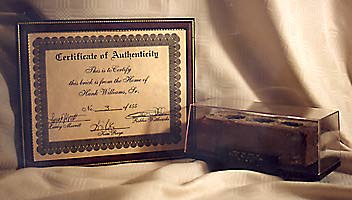
Click on the Brick
...and find how you can obtain a piece of Hank Williams Sr.'s home.
Grady Owen (a former Blue Cap) Dies
Dec. 8, 1999 - Gray Owen's nephew reports:
"I regret to inform you that I've just received word that my uncle,
Grady Owen, passed away November 16 in the Philippeans. I have no word
yet on cause or circumstances.
I also just wanted to say thanks to Rod and Bob at the Rockabilly Hall of Fame. If you had not
requested a bio of Grady, I might never have made the effort to track
him down and contact him. Because of your request, I was able to
maintain a pleasant correspondance with him the last year and a half,
and learn a great deal about his fascinating life and career in the
music biz, especially his days with Gene Vincent.
Grady is survived by his Wife, Teting, and a number of children, who
I will list when I can get that info together. I'll also try to send
some additional info for the bio which I had received from him after the
article was written.
Grady was thrilled to know that he still had fans, and was a part of
your website. He received a number of letters from old friends and fans
because of it, and I think it certainly enriched the last year of his
life."
Grady played rhythm guitar, bass and did vocals for Gene Vincent on Gene's 1958 recording sessions at Hollywood's
Capitol Towers in March and October. After the October sessions, the Blue Caps disbanded. Grady was on
some of Gene's best tunes: Git It, Dance in the Street, Rocky Road Blues and The Wayward Wind (in March) and
Say Mama, Important Words, Who's Pushin' Your Swing and Over the Rainbow (in October>.

New Billy Lee Riley / Sonny Burgess CDs
Billy Lee - Initial release is a limited pressing, autographed collectible,
available by the end of the month. The disc is titled "Shade Tree Blues" and is
on his own Sun-Up record label. This is a blues disc in a similar vein to "Hot
Damn!", his last CD. The first 1,000 copies will be special collectors
editions. They will be numbered in gold (the numbers being issued in the order
that the discs are ordered, so order early if you want a lower number). Each
disc will be signed in gold pen on the disc itself by Riley and will be
accompanied by a certificate of authenticity, also signed by Riley. As a little
aside, Billy is doing all the work on this himself, so if you order a disc, it
will actually be him that stuffs it in the envelope!
The cost of the disc is $20 (postage included) for domestic U.S. orders, all
oversees orders (including Canada) are $22.
To order, send a check or money order to:
Billy Lee Riley
302 Marchand St.
Newport, Arkansas, 72112.
New Sonny Burgress CD.
"They Came from the South" by Sonny Burgess and the Legendary Pacers is
available direct from:
Sonny Burgess
PO Box 215
Diaz Newport, AR 72043 USA
The cost is $20.00 and Sonny will add an autographed photo as well.
The Rockabilly Hall of Fame is pleased to announce that the board of the "Arkansas Walk of Fame" located
in Hot Springs Arkansas, has voted in favor on Steve Lester's nomination of Mr. Billy Lee
Riley. Billy will be inducted in an official ceremony in Hot Springs which
should take place sometime in the Spring or Summer of 2000. We will post more information here when it
becomes available. (Good work, Steve)
Rockabilly Syndicated TV Show
 What's it called? "The Lou Hobbs International ROCKABILLY HALL OF FAME Show."
Lou Hobbs has been video taping and editing over past several months
and released his
initial rockabilly show in June of 1999, airing in 225 cities in all or portion of Illinois,
Tennessee, Kentucky, Arkansas and Missouri. Artists featured on this 30-minute program, the first of 13 monthly shows,
are: Marco DiMaggio, Hayden Thompson, Glen Glenn, Narvel Felts and others. Lou plans a 60-minute special for
December. Bob Timmers, curator of the RaB HoF comments, "I think this is a first and we are glad to be
a part of it! Let's hope it catches on throughout the US and beyond. Go get 'em Lou!"
For more information regarding syndication or interviewing/performing contact:
Timberwolf Productions, P.O. Box 821, Cape Girardeau, MO 63702 USA, (573) 335-5712 Phone, (573) 335-7365 Fax.
E-mail: twolf@1dd.net e-mail - Originating station, KFVS, Cape Girardeau, MO.
What's it called? "The Lou Hobbs International ROCKABILLY HALL OF FAME Show."
Lou Hobbs has been video taping and editing over past several months
and released his
initial rockabilly show in June of 1999, airing in 225 cities in all or portion of Illinois,
Tennessee, Kentucky, Arkansas and Missouri. Artists featured on this 30-minute program, the first of 13 monthly shows,
are: Marco DiMaggio, Hayden Thompson, Glen Glenn, Narvel Felts and others. Lou plans a 60-minute special for
December. Bob Timmers, curator of the RaB HoF comments, "I think this is a first and we are glad to be
a part of it! Let's hope it catches on throughout the US and beyond. Go get 'em Lou!"
For more information regarding syndication or interviewing/performing contact:
Timberwolf Productions, P.O. Box 821, Cape Girardeau, MO 63702 USA, (573) 335-5712 Phone, (573) 335-7365 Fax.
E-mail: twolf@1dd.net e-mail - Originating station, KFVS, Cape Girardeau, MO.
Buddy Knox Mailing List

Join the
BUDDY KNOX mailing list. Get on line with other fans of
Buddy and his music.
 Jodimar Guitarist
Charlie Hess Dies
Marshall Lytle reported Fri., Oct. 29, 1999 that Charlie (Chuck) Hess a/k/a Ty Hesten, has died at
the age of 67. Chuck was the great guitar player with the Jodimars, and will be remembered for
the wonderful solos on their Capitol Recordings made in the mid 50's. He played his guitar
right till the end, he died about 1:30 am in his van on his way home from a gig in Leesburg
FL. If any one would like to pay respects ... he is servived by his wife Judy Heston her address
is 2503 South Street Apt #63, Leesburg Fl. 34748. He will be missed but thank God we have his
guitar playing to remember.
Lotsa Love, Marshall
"Heartbreak Hotel" Lyricist Dies
BAY CITY, Mich. Thomas Durden, who wrote the lyrics to one of Elvis Presley's early big hits,"Heartbreak
Hotel," has died at age 79.
"He wrote a lot of good music that is out there. It's just that `Heartbreak Hotel' is the famous one," said his stepson,
John White.
Durden, who died Sunday at his home in Houghton Lake, met Presley as a result of the song. Presley called him"sir"
and sent Durden Christmas cards to show his appreciation, White said.
Durden co-wrote"Heartbreak Hotel" with Mae Boren Axton of Nashville, Tenn., who died in 1997. For reasons never
explained, Presley also was given writing credit even though it was the work of Durden and Axton.
Durden was born in Georgia and grew up in Florida, where his older brother had a musical influence on him. Durden
had a good voice and a special talent for playing the steel guitar, which he refined throughout his life, White said.
In 1956, Durden was single and performing with a band in Jacksonville, Fla., when he came across a newspaper
account of a man who had committed suicide, White said.
The man left a note that said,"I walk a lonely street," and Durden used it as the basis for"Heartbreak Hotel."
Durden continued to write and perform music, playing with Nashville legends like Johnny Cash and touring with Tex
Ritter, White said.
He moved north to the Houghton Lake area and lived there for about 40 years. He performed with bands in northern
Michigan, and their sets always included his hit song, White said.
In a 1982 interview, Durden spoke of the impact"Heartbreak Hotel" had on his life.
"I wish I had 12 more songs just like it," Durden said."It has paid the rent for more than 20 years, but you can't get
rich writing songs unless you have a lot of big ones."
Orbison Bootlegs Released as Four-disc Set
Those who felt the heart attack that claimed Roy Orbison's life in
December 1988 stifled one of the most vital comebacks in rock & roll
history, will find some comfort in next week's release of the Roy Orbison
Authorized Bootleg Collection on Orbison Records. With Orbison's
widow, Barbara, serving as executive producer, this release pulls
together four complete Orbison performances -- Batley, England, from
1969; Hornchurch, England, from October, 1975; Stockton, England,
from March, 1980; and Birmingham, Ala., from July, 1980 -- into a
four-disc, slipcase edition.
The collection is the first offering in a series of authorized live recordings.
"The bootleg series has been on the release schedule for a long time,"
Barbara Orbison says of the project. "Whenever I go to Europe, or when
I'm in a record store here, I always find live recordings of Roy that are
released by a bootlegger, and they charge so much for it. So I decided to
take the four most bootlegged albums and to put them out into one CD
set. It will be on the street for $24.98."
Orbison has spent years poring through her husband's material,
choosing songs and editing out blemishes from the masters -- primarily as
a favor to his dedicated fan base. "It is truly for the fans," Barbara says. "I
only knew Roy by his live performances, because he didn't listen to his
own recordings. His live shows were so incredible. Each night when he
stepped on stage, he just gave it his all. Roy would have cringed to have
thought that somebody recorded those shows and then bootlegged
them. He used to feel very uneasy when a fan would come and give him a
bootleg to autograph. He would say to his manager, 'Where did this come
from?' But, you know, it was fan-bought, so he had to smile."
In addition to stamping out bootlegs with this set, Orbison Records has
other projects on the burner in varying stages of development. Next up
will be the November DVD release of Black and White Night, a
star-studded Orbison concert from 1987 featuring Bruce Springsteen,
Elvis Costello, Bonnie Raitt and k.d. lang.
The four performances included in the box draw attention to Orbison's
reverence for other songwriters. Covers of the Beach Boys' "Help Me
Rhonda," the Louvin Brothers' "When I Stop Dreaming" and Willie
Nelson's "Pretty Paper" all appear with Orbison's inimitable accents.
Barbara would like to organize a similar tribute to Roy. "I would love to do a
project that's a tribute to Roy Orbison, the songwriter," she says. "If you
asked Roy, he would have said, 'I love my voice, I've always considered it
a gift from God, but sometimes the songwriter Roy Orbison gets angry at
the singer Roy Orbison.' That voice has prevented many contemporaries
and new artists from taking a song of his. And Roy would have said he
thought the songwriter Roy Orbison was never really as applauded like the singer."
But such a project hasn't moved beyond a proposal at this point yet.
"There are certain artists and friends that really appreciated Roy that said,
'Anytime, phone me,'" she says. "But it's such an undertaking."
In the meantime, Barbara might look to the vaults again for a tribute by
other artists. "I have a great concert, when his friends got together for the
Roy Orbison tribute in 1991 at the Universal Ampitheater," she says.
"Everybody from Dwight Yoakam to the Byrds to Pete Townshend to k.d.
lang to Bonnie Raitt to NRBQ. And John Fogerty, everybody came. But I
haven't put it on CD form yet."
This month will also see the launch of a revamped www.orbison.com, run
by Orbison fans under the supervision of Barbara Orbison Productions. In
addition to information on all things Roy, the site also offers his albums
and will include the Bootleg Collection.
--ANDREW DANSBY
(October 15, 1999)
Music Pioneer Ella Mae Morse Dies
Bullhead City, Ariz. (10/17/99) Ella Mae Morse, whose classic
1942 recording "Cow Cow Boogie" became Capitol Records' first million-selling single,
died Saturday. She was 75. Ella Mae had been suffering respiratory problems following a long illness.
The Texas-born Morse combined boogie woogie, blues, jazz, swing and
country influences in the 1940s and 50s, helping to create a pioneering
"pop" sound that would later grown into rock 'n' roll. Elvis Presley
even praised her for teaching him how to sing.
Describe as a black-trained, white "hepchick," her songs earned her 10
gold records. One song was the "The House of Blue Lights," which is
regarded as one of the most influential songs in the evolution of rock
'n' roll, said Alan Eichler, her publicist.
Morse stopped recording in 1957, but continued performing until 1987.
There's been a "Murder on Music Row"
 Shell Point Records, located in Nashville, Tennessee, will officially launch
with the October release of Larry Cordle and Lonesome Standard Time's new CD "Murder On Music Row,"
according to label President and National Sales/Promotion Director Randy Harrell.
Shell Point Records, located in Nashville, Tennessee, will officially launch
with the October release of Larry Cordle and Lonesome Standard Time's new CD "Murder On Music Row,"
according to label President and National Sales/Promotion Director Randy Harrell.
"It is an honor to have Larry Cordle and Lonesome Standard Time as the flagship act on Shell Point Records,"
said Harrell. "The particular brand of country produced by this group of excellent musicians is real, honest
country that pays homage to the folks that made Nashville great. We are proud to release a record that is
uncompromising in all aspects."
Grammy nominated entertainer and songwriter Larry Cordle has had songs recorded by Garth Brooks, George Strait,
Reba McEntire, Trisha Yearwood, George Jones, Ricky Skaggs, Kenny Chesney, Alison Krauss, Diamond Rio,
Kathy Mattea, Sammy Kershaw, John Michael Montgomery, and Gene Watson to name a few. Cordle's songs have appeared
on CDs selling in excess of 44 million units. Cordle has previously recorded three projects for Sugar Hill Records.
Larry Cordle and Lonesome Standard Time are: Larry Cordle, acoustic guitar and lead vocal; Terry Eldredge, upright
bass and tenor harmony vocal; Booie Beech, acoustic lead guitar; Fred Carpenter, fiddle; David Harvey, mandolin;
and David Talbot, Scruggs-style banjo.
Shell Point Records personnel also include A&R consultant Larry Shell, a successful Songwriter/publisher who served
as A&R director for A&M Records in Nashville from 1994-96. Shell was also instrumental in the formation of Shell Point
Publishing and Gehl Force Music. Shell Point sales representatives include Greg Kaiser, Southeastern Sales
Representative, and Chris Kuprionis, Midwestern Sales Representative.
Shell Point Entertainment has retained the services of Empire Management Group, located in Nashville, TN, to provide
certain strategic capital structure as well as merger and acquisition advisory services. Empire Management Group is a
business advisory firm providing comprehensive management services as well as sport and entertainment celebrity
and executive representation. EMG is a wholly owned subsidiary of Empire Financial Group, Inc., a boutique financial
advisory and portfolio management firm to private clients worldwide.
"We are pleased that Empire Management Group is assisting Shell Point Music in evaluating strategic alternatives as
we move forward with the launch of Shell Point Records," said Randy Harrell, Shell Point Records President and
Chief Executive Officer.
For more information regarding Shell Point Records or Larry Cordle and Lonesome Standard Time please contact
Ray Crabtree Public Relations, (615) 255-7225, e-mail: rcrabt7478@aol.com or Lance Cowan, LCMedia (615) 331-1710,
e-mail: lcmedia@sprynet.com.
REVIEW --
"Great Balls of Fire"
Musical, Cambridge Theater, London
This musical based on the Jerry Lee Lewis story opens officially in
London's West End on October 6th, after pre-West End runs in Plymouth and
Birmingham, England. Eleven die-hard Jerry Lee fans went to a preview on October 4th, and all
agreed it was a great show which deserves to run and run. Billy Geraghty, who
played Buddy Holly in the musical Buddy years ago, does a tremendous job acting
the role of The Killer, and also singing and playing piano in his style as
well. He played the role originally in Coventry, England some years ago in an
earlier production called Whole Lotta Shakin' Goin' On.
The current production has been refined since its opening runs in the
English provinces. A scene featuring Jerry's 1964 Granada TV special with English
fans clustered around the piano has been cut and other scenes altered. However
the finale has been extended to create a powerful climax, which suggests Jerry
Lee is still very much rocking his life away.
The chronological accuracy of the musical is very shaky indeed, but then
it is of necessity a representation of events in Jerry's life rather than a
biography. So we get Jerry singing numbers like Wild One and No Headstone On My Grave
years before he recorded them or included them in live shows, and we get Linda
Gail playing guitar and singing a duet with Jerry on She Even Woke Me Up To Say
Goodbye, which works beautifully, but it is not a number I have ever heard sung
as a duet, nor have I seen Linda play guitar. (Linda attended the
opening night in person). In the Waxahatchie Bible Institute scene Jerry actually
sings as well as plays piano on My God Is Real, but just to have him
accompanying a singer would not really have worked in the musical. So all in all a pretty
fair representation of key events in Jerry's life, and a good selection of
songs from the early days to his later material.
So much has happened in Jerry's life that lots had to be omitted - the
deaths of various close family members, the life-threatening hospitalizations due to
a torn stomach and subsequent complications and other incidents could not
all be fitted into a two and a half hour musical. Having said that, the funeral
of Jerry's son Steve Allen was a bit too drawn out and depressing - perhaps
it could have been shortened, or replaced by a short scene depicting all the
funerals Jerry has attended involving his close family merged into one.
This would have heightened the great sense of tragedy in his life. But these are minor points, not
even worthy of the term 'criticisms'. The show
is truly brilliant, and much better than the movie of the same title because it
digs deeper into Jerry's character and feelings, and also follows his
career to his renewed success as a top country star in the 1970s and beyond.
The most memorable scene for me, beating even the fantastic finale, is the
close of the first half when Jerry appears in Kilburn, London during the fateful
1958 tour. He strides on stage to cries of 'cradle-snatcher' wearing a bright
red suit with black velvet trimmings, and starts combing his long wavy blond
locks - looking outrageously camp even now, so imagine the impact over 40 years
ago! He was already branded as a bigamist who married his 13-year old cousin, and
in person he looked brash, right over-the-top, positively dangerous and
threatening, like rock'n'roll itself. He then does a pulverizing show, and
in a dramatic piece of poetic license sets fire to the piano and gives the
finger to the British critics as he storms off stage telling them to 'kiss my ass'
if they don't like Jerry Lee's rock'n'roll lifestyle. Of course this never
actually happened at that time and place, but it makes the required impact and
shows what Jerry Lee was all about - the true and original rock'n'roll rebel who
couldn't be managed or tamed.
The story ends with Jerry's triumphant debut at the Grand Ole Opry riding
at the top of the charts with hit after hit, some of which crossed-over to the
pop charts. He does rocking country, beautiful ballads and pure unadulterated
rock'n'roll. He introduces Kris Kristofferson's 'Me And Bobby McGhee'
saying: 'It's a Jerry Lee Lewis song now' before proceeding to rock it to bits.
Billy really captures both the essence and detail of the man. He follows
Jerry's phrasing in many numbers, his adlibs and his trademarks - it is almost
like watching the real thing. Watching Billy jump on the grand piano in one
scene and seeing the whole instrument wobble and shake precariously one wonders how
many they will get thru if the production runs any length of time.
If this show doesn't take off, then there is no justice. If people go to
see it, they will like it, there is no doubt about that. The audience at the
preview were certainly lapping it up.
Tony Papard, October 5th, 1999
Merle Haggard's Autobiography
"I've had a blessed life, despite many lows, many of which were of
my own doing," Merle Haggard writes in the preface of his
just-released autobiography, "Merle Haggard's My House Of Memories: For
The Record." "There have been times I simply could not see the light at
the end of an economic, romantic, psychological, or emotional tunnel.
If anyone had ever told me I'd be as content as I am today, I would have
thought they were talking about someone else."
From his childhood spent in a
converted boxcar, through seventeen incarcerations and
decades of drugs, alcohol, gambling and divorce, Haggard's dark
side was often overlooked, at least in the public eye, due to his
"common man" way with words and music.
FOR MORE ON MERLE, see
Barry Klein's Review: Front Row at "The Hag's" Pay-TV Vegas Show
Austin City Limits 25th Anniversary Book
Billboard Books is celebrating the extraordinary quarter-century anniversary
of the longest running music showcase in television history with a new book entitled "Austin City Limits, 25 Years
of American Music." Austin City Limits draws on the huge archive of
American roots music presented on the PBS series, and captures the excitement of the show with over 300
up-close and personal photographs depicting the finest country, blues, folk, jazz, tejano, bluegrass, rock, and pop
artists of our time.
Written by renown music critic John T. Davis, with photographs by Scott Newton and a foreword by Lyle Lovett,
Austin City Limits truly reflects the spirit of the show's stellar cast of performers, documenting in words,
pictures, and anecdotes, and behind-the-scenes images, the performances of the more than 500 stellar recording
artists including:
Willie Nelson, Lucinda Williams, Roy Orbison, Stevie Ray Vaughan, Lyle Lovett, Leonard Cohen, Johnny Cash,
Lightnin' Hopkins, Son Volt, Tammy Wynette, Ruth Brown, John Denver, Lionel Hampton, Neil Young, Emmylou
Harris, Garth Brooks, The Neville Brothers, Kelly Willis, Sheryl Crow, Bonnie Raitt, Hal Ketchum, B.B. King, Ray
Charles, Tom Waits, and so many more.
"Austin City Limits" launches its 25th broadcast anniversary season in February 2000 on PBS. "Austin City
Limits" is a production on KLRU/Austin, the Capital of Texas Public Telecommunications Council. Visit the
"Austin City Limits" website at: http://www.austincitylimits.com
Austin City Limits, 25 Years of American Music: by John T. Davis
192 pages / 8-1/2 x 10-1/2 / 250 color and 50 b/w illustrations
0-8230-8303-9 / $35.00 Hardcover / October
Eddie Bond Recommends
... that you visit and support the
Sheriff
BUFFORD PUSSER Home & Museum Website. Eddie is releasing a new song dedicated to Bufford. See story below.
An Enchanced Patsy Cline Creates Duets
Patsy Cline is singing, her voice clear and true, in duets with some people she never heard of - Bob Carlisle,
Beth Nielsen Chapman, Glen Campbell - and one person she undoubtedly did know, Willie Nelson.
The doctored duets were made possible by new technology with the potential for embellishing - or
desecrating, depending on your point of view - the work of countless musicians who are no longer
able to speak for themselves.
"I think people want to hear the superstars and icons of music the way they actually were," said
Michael Blakey, producer of the new Patsy Cline "Duets" album. "With recording technology the
way it is, you couldn't hear what they were capable of doing. You were only getting 50 percent of
the story."
Her music, a blend of country and pop, is appreciated more now than it was before she died at the
age of 30, in a Tennessee plane crash. A disc of her greatest hits, including "Crazy," "I Fall to
Pieces" and "Walkin' After Midnight," has sold more than 8 million copies.
These recordings are definitely hit-or-miss with country fans, said Robert Oermann, a music
historian and author of the upcoming book, "Century of Country." Although there doesn't appear
much anticipation for the Cline project, it's a tribute to her longevity that there's still interest in her
music, he said.
Viva Las Vegas Update
(September 26, 1999). Tom Ingram has announced that Viva Las Vegas has
changed their mailing list. If you would like to be on their mailing list then please send a blank message to:
vivalasvegasnews-subscribe@listbot.com
or fill out the form at their website at:
http:/www.vivalasvegas.net/. -
With over 6 months to go the Gold Coast Hotel is now completely sold out. There are still rooms available
at a special rate in The Orleans. Phone 1 888 402 6278 from USA 1 702 367 7111 from outside or
book online via the vlv website.
BANDS ADDED TO VLV 2000
Skinny Mcgee & Mayhem Makers
Blue Ribbon Boys
Chester Everett & The Ranch Rhythmaires
King Memphis
Del Bombers
Wild Wax Combo
& more to be added to THE GREATEST ROCKABILLY SHOW ON THE PLANET
Also: The Rockabilly HOF to Have Stage at VLV 2000
Ritchie Valens Named Among This Year's
Rock & Roll Hall of Fame Nominees
September 24, 1999 - Del-Fi Records are proud to announce that
Ritchie Valens was listed among the fifteen nominees on
this year's ballot for induction into the Rock & Roll Hall of
Fame & Museum in Cleveland, OH.
More than 800 writers, artists, producers, broadcasters
and music industry executives received their ballots this
week and have until mid-October to decide who will be
inducted.
The fifteenth annual induction ceremony is scheduled for
sometime in March 2000 (the exact date will be announced
along with the names of the official inductees -- up to seven
names -- sometime in November).
In order to be considered for nomination, a band or artist's
debut album has to be at least twenty-five years old, and
although Ritchie has been eligible since 1984, and has
been nominated before (including last year) making the
list again this year is still considered quite an honor.
In the past few years, Del-Fi Records have joined forces
with numerous partners --- including Westwood One, ABC
Pure Gold Networks, the Jones Radio Networks, and
countless Oldies radio stations, coordinating a massive
petition and postcard campaign in numerous U.S. cities,
special on-air giveaways, and gathering signatures of
support from thousands of Ritchie's fans across the entire
world.
This year, Valens received a strong show of support from
RIAA president & CEO Hilary Rosen, and Congressman
Howard L. Berman (Democrat - Mission Hills, California).
"We're thrilled with the news," says Bob Keane, president
of Del-Fi and Ritchie's only producer. "His nomination once
again proves that people all over the world have not forgotten
him. It's terrific to see that he's still remembered over forty
years after his untimely death."
Valens has been honored with a U.S. postage stamp and
he was awarded a star on the Hollywood Walk of Fame.
The and the story of his life & music was the subject of a
1986 motion picture, La Bamba.
On February 3rd this year, the 40th anniversary of his death,
Valens was remembered in a VH1 - Behind The Music one-hour
special on "The Day The Music Died."
Since 1958, Ritchie's music has reached across the U.S.
and around the globe. His rockin' "La Bamba" is one of the
most recognized songs throughout the world, and his other
hits, "Donna" (#2 in the U.S. at the time of his death) and
"Come On, Let's Go," also continue to thrive from daily
heavy Oldies rotation.
"When Ritchie Valens was nominated last year, Oldies
formats responded with an enthusiasm the likes which
we'd never seen before," responded Elliot Kendall, Del-Fi's
Director of Radio Promotion upon hearing about Valens'
nomination again this year. "This year, the enthusiasm has
been continuous, and hearing that Phil Spector was behind
us has only added fuel to our passion for Ritchie's induction.
This very well could be Ritchie's year!"
[Spector is one of the Nominating Committee members who
has been championing Valens' contributions to Rock n' Roll
for years; the two met while Ritchie was recording his first
single, "Come On, Let's Go" at Gold Star Studios and Spector
was recording "To Know Him Is To Love Him" around the
same time with his vocal group, The Teddy Bears.]
In May 1998, Del-Fi issued Come On, Let's Go!, a 3CD box
set of the complete recordings Ritchie made before his tragic
death in February 1959. The 62-track collection-which includes
a set of Rock & Roll Hall of Fame postcards for fans who want
to add their names to the growing list of supporters --- reminds
those who may have forgotten, and informs those who never
knew, that Valens was a formidable musician whose death
robbed rock n' roll of a great talent.
To interview Bob Keane regarding Ritchie Valens, or for
more information about Del-Fi Records, please contact Bryan
Thomas, Director of Publicity, at promo@del-fi.com or phone
(800) 993-3534. If you are interested in participating with Del-Fi in a special
Ritchie Valens digital download promotion or custom-disc
promotions, please contact Gary Tanenbaum, VP of Operations,
at gary@del-fi.com
David Dennard Rounds Up
"Big D Jamboree" Performances
From the web version of the Dallas Observer (http://www.dallasobserver.com) - Robert Wilonsky
David Dennard is doing God's work -- if your definition of God is,
say, Johnny Cash or Carl Perkins or Gene Vincent. Come January, the
man responsible for releasing collections celebrating the
rare-and-unreleased work of such local heroes as Johnny Dollar and
"Groovey" Joe Poovey will ship to stores what's easily among the most
significant and valuable album ever to come from this city. And
that's no hyperbole, either, considering the two-disc Live From the
Big "D" Jamboree, 1957-59 features never-before-heard performances by
the likes of Cash (including "I Walk the Line"), Perkins ("Blue Suede
Shoes" and "That's All Right Mama," among others), Vincent ("Whole
Lotta Shakin' Goin' On"), Wanda Jackson, Ronnie Dawson, Sid King, and
dozens of other musicians -- all performing live, very live, on the
old Sportatorium stage.
The collection -- which is divided into two discs, "Rockabillies"
(Jerry Reed, Warren Smith, and others) and "Hillbillies" (Orville
Couch, Cowboy Copas, Leon Payne, and many more) -- was supposed to be
in stores next month. But a hard-drive crash at Phil York's mastering
lab "shot to shit my release schedule," Dennard says, explaining that
half a disc was lost during the meltdown. To that end, he has put off
the release date of the discs -- which will feature never-before-seen
pictures and extensive liner notes by Fort Worth-based Western swing
aficionado Kevin Coffey -- till the second week of January on his
Dragon Street Records label. "We'll have power back by then," he
says, cracking Y2K.
But what's three more months of waiting? After all, this material has
been sitting in the Library of Congress vaults for decades, until
Dennard discovered it while working on his terrific 1998 Gene Vincent
collection, The Lost Dallas Sessions. In the Library's basement,
Dennard discovered 15 minutes of Vincent and his Blue Caps performing
at the Sportatorium during the late 1950s -- in addition to dozens of
other performances not only from the Big "D" Jamboree, but from
myriad other barn dances all over the country, including the famed
Louisiana Hayride.
Dennard suggests there are several more albums waiting to be made
from his discoveries. "I could make a career out of this -- licensing
the rights to people from the various shows," he says. "It's like
having a big turkey to carve up." But he's first and foremost
concerned with the Dallas collection, which features more than 30
different beloved heroes and unrenowned legends playing championship
ball at the peaks of their games. Indeed, the Cash and Perkins
performances alone make the disc invaluable, catching the two men
before their Sun set.
Dennard says it wasn't at all difficult to get clearance from Cash's
businesspeople to use the material. After all, they're aware of how
little money there is to be made packaging such venerable material.
Besides, Dennard says, "Johnny's also ill and is interested in his
legacy. He was flattered to be included and flattered we cleared it
instead of bootlegging it, like they do in Europe. He was
appreciative I went through the trouble, according to his manager.
And he fondly remembers the Jamboree; he was always well-received
there." Indeed, it sounds like Beatlemania when Cash launches into
his extraordinary performance of "Get Rhythm." But what makes this a
remarkable live recording is that the song never struggles to be
heard over the rousing applause.
Dennard admits there's not much money to be made doing projects such
as these. He insists he does it for the sole reason of preserving the
past -- or, in his words, "giving credit where it's due." He's the
proud native son in love with the idea of reminding folks that
Dallas, for a brief moment, was an important stop on the
rock-and-roll time line. Now, if only he could find Hank Williams'
and Elvis Presley's Big "D" Jamboree performances.
"This has been the coolest thing I've ever been involved in," says
Dennard. "It's taken me all over East Texas and South Oak Cliff. I've
met people in their twilight years. It's just incredible. It's like
researching a historical project, which, I guess, this is.
Unfortunately, these people don't sell records anymore. But I'll be
happy if an astronaut's listening to it on a space station 20 years
from now. That's all I really want."
Billy Adams Rocks at the
Buddy Holly Tribute in Nashville
Tuesday, September 7, 1999, at the Exit/In on Elliston Place in Nashville,
Tennessee, was definitely THE place to be as many of Nashville's most
talented musicians, writers and performers took the stage during Billy
Block's Western Roots Revival to celebrate what would have been Buddy Holly's
63rd birthday, a show coordinated by Robert Reynolds of the Mavericks.
Among the stellar lineup of artists paying tribute to Buddy Holly was Robert
Reynolds, Kim Richey, Bob Delavante, Bill Lloyd, Chris Scruggs, Kevin
Montgomery, Janet Lynn, Brent Wilson and the original rockabilly man himself,
Billy Adams. While each artist performed one Buddy Holly tune, Billy Adams
rocked with one Buddy Holly song and two of Billy's originals, "Rock Pretty
Mama" and "You Heard Me Knockin'". Billy brought the audience to their feet
for two standing ovations. The applause and shouts for "more, more more" was
overwhelming particularly since it was Billy's first performance in Nashville
and his first rockabilly performance in forty years. The entire show was
broadcast live over the Internet and can be viewed on Western Beat Roots
Revival at LiveOnTheNet.com.
The words "awesome" and "fantastic" were repeated more times that night to
describe Billy's performance than one can possibly count. People rushed
forward to shake his hand, congratulate him and speak with him.
One of the evening's greatest compliments came from Robert Reynolds of The
Mavericks who performed and hosted the tribute. His comment captured the
performance in one sentence; "Billy, in every show there is a high point.
Tonight, Billy, you are that high point."
Bo Diddley to Guest Star On Disney TV
Bo Diddley will guest star in an upcoming episode of
Disney Channel's original series, "So Weird." The episode, entitled "Blues," will shoot September 21-22 in
Vancouver, and will premiere Friday, January 21, 2000, 7PM ET/PT on Disney Channel. Set visits and interviews
are available upon request.
In "Blues," Molly's tour is on the way down to a gig at an old Blues club in Mississippi when Molly, Fi, Jack, Carey
and Ned all appear to be channeling part of the same old Blues song. Fi finds that lyrics to the song give them
clues to evil doings against the songwriter, whose music was stolen by his murderer. Diddley guest stars as
Frank, the record shop owner. The episode also guest stars Marlene Warfield (Network; Jo Jo Dancer, Your Life Is
Calling) as Mrs. Clemens, the Blues club's owner.
"So Weird" chronicles Fi, her 15-year-old brother, Jack, and Molly, their rock star mom, in their home on wheels
-- a custom touring bus -- as they travel across the United States. A popular musician in the '80s, Molly is on a
"comeback" tour and delighted that her children can travel with her. Also along for the trip are Jack and Fi's
friend Carey Bell, his dad, Ned, who acts as the band's roadie and his mom, Irene, who is the band's manager. In
each city the tour visits, Fi encounters and explores various mysteries of the paranormal. Fi attempts to solve
these mysteries as they arise, using the website she created, 'Fi's So Weird Website' to gather clues and
information. Other notable "So Weird" guest stars include Henry Winkler in "Boo," Dionne Warwick in "Lost" and
Country music sensation SHeDAISY in "Listen."
A living legend, Bo Diddley is a true pioneer of Rock 'n' Roll and a member of The Rock 'n' Roll Hall of Fame. For
four decades, his unique style has influenced many performers including The Beatles and The Rolling Stones. In
February 1998, Bo Diddley received the "Lifetime Achievement Award" at the Grammy Awards.
Little Richard Files Suit/Works with NBC
Little Richard has filed suit against a U.K. company for more than $200,000, claiming that it reneged on an agreement
to have the rock and roller perform on British soil. In a suit filed in Los Angeles Superior Court on Thursday (Sept. 9),
Little Richard, whose real name is Richard Wayne Penniman, alleged that he entered into a verbal agreement with the
Flying Music Co. on March 29, to pay him $210,000 for seven concerts. Flying Music Co. eventually canceled the
concerts, and Richard is looking to reclaim his fee, and to cover his legal costs.
In other Little Richard news, the "Tutti Frutti" singer has given the go-ahead to NBC to produce a biopic for sweeps week.
Production on the project is slated to kick off in November.
Rockin' By The Bay! GREASEBALL '99
The 5th Annual San Francisco Rockabilly Weekender
Saturday, October 2nd and Sunday, October 3rd at the
Transmission Theater and Paradise Lounge
At the Corner of 11th & Folsom Sts., San Francisco.
THE GREASEBALL is a celebration of Rockabilly showcasing no less than 12
acts from the U.S. and abroad. A life-long fan of Rockabilly, with more than
10-years of experience booking shows, "Greaseball" founder August Ragone has
been working hard to establish this event as a nexus for Rockabilly fans the
world over to see music in our "Baghdad-by-the-Bay."
Confirmed and signed for GREASEBALL '99 are:
THE WESTERN STAR TRIO (England) -
HOT ROD LINCOLN (San Diego) -
THE HAYWOODS (Santa Cruz) -
THE DEL BOMBERS (Seattle) -
RIP CARSON & THE TWILIGHT TRIO (San Diego) -
DANNY DEAN & THE HOMEWRECKERS (Los Angeles) -
PEE WEE & HIS SAFE CRACKERS (Oakland) -
RANDY BECKETT'S REBEL TRAIN (Downey) -
THE HOT ROD TRIO (Fountain Valley) -
and currently waiting for at least five more bands to sign contracts
in the coming week.
The Greaseball '99 will not just feature rockin' acts from the four-corners,
top international DJs who will keep the atmosphere goin' both days & nights.
Our featured wax-masters are led by DJ Tak (Japan), Jumpin' James Shelton
(of the Bigfoot Lodge), Vita Lee (KKUP Radio), King Vidor (Bombay) and more
to be announced. The 3nd Annual "Bad Girl Pin-Up Contest" is scheduled for Saturday Night!
Be a part of the Greaseball '99!
€Rod & Customs Show (both days)
Fee required for reserved parking and entry. Write for information (car
clubs welcome and encouraged). Billet-Proof and Pre-1966 Cars Only!
€Bad Girl Pin-Up Contest (Saturday Night)
No entry fee -- just sign up early on Saturday! Contest to be held at
approximately 10 pm that night! That's right, so all you Femme Fatales can
compete for a chance at immortality, and wear the coveted "Ms. Greaseball"
Crown! Be crowned by "Ms. Greaseball '98," Ms. Telma! Win prizes!
€Tattoos (both days) By "Mom's Tattoos" of San Francisco.
€Dance Contest (both days)
Schedule and Conditions to be announced. €Fashion Show (date TBA)
Sponsored by Graziella of Guys and Dolls.
€Vendors (both days) We have limited space this year! Sign up right now!
For more information on Vendor's Stalls, Rod & Custom Show, and Pin Up
Contest, send a manilla-size SASE, with your request to: Greaseball Info,
1726 Divisadero, San Francisco, CA 94005.
The BEST thing about the Greaseball '99? The price: $30.00 in advance -- for
BOTH days! Not $30.00 per day and certainly NOT $50.00 for both days -- The
Greaseball'99 is all yours for the low-low price of ONLY $30.00 ($35.00 at
the door day of show).
More information to be announced shortly -- as well as the skinny on the
Greaseball Pre and After Parties! Unfortunately our website is under
extensive reconstruction... e-mail: kaijupro@sirius.com for our e-mailing
list! Come to San Francisco! Rock by the Bay! DON'T MISS OUT ON THE GREASEBALL '99
WEEKENDER!
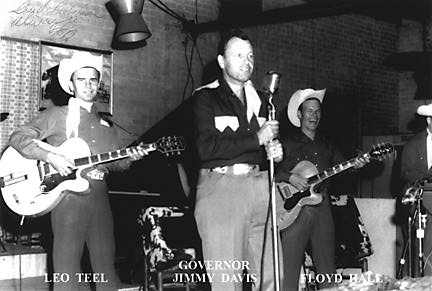
100 Years of Sunshine:
Jimmie Davis turned 100 September 11th!
Mack Stevens Again at Rollin' Rock
Savage Texas Rebel MACK STEVENS has returned to Rollin' Rock to record his
third CD for the label.
The Mackster mixes it up pretty good starting with lunatunes such as "Psycho"
to happy Haleysh swingers such as "Here We Go Again--Rock, Rock, Rock" to
bordello Western fare such as "She's Not Bad".
Mack Stevens' "Goodbye Train" is currently Number 2 in the Hit Parade of
Dutch magazine "Boppin' Around".
Eddie Cochran Rock'N'Roll Weekend
... at the Olympiad Leisure Centre, Chippenham, England Friday October 1st - Sunday October 3rd
The 'Blue Caps' are heading for Chippenham! Yes in October, four members of Gene Vincent's 1957 Blue Caps -
Tommy Facenda, Dickie Harrell, Paul Peek and Johnny Meeks,
will headline the 5th Eddie Cochran Festival in an exclusive UK concert on Saturday, October 2nd at
the Olympiad Leisure Centre Chippenham.
The theme of this year's festivale will be to pay tribute to both Eddie Cochran and Gene
Vincent, very close friends, who had toured together all over the world in the late 50's. It was
in 1960, when Eddie and Gene were touring the UK together, that the fateful accident occurred at
Rowden hill on April 18th.
Appearing with The Blue Caps will be guest artist Bobby Cochran, who will be here for his
3rd festival backed by three of the UK's top recording and session musicians, and special
guest Marco Di Maggio, who is flying in direct from Florence Italy with the Di Maggio
Brothers for an exclusive performance. Brian Hodgson, former member of Matchbox and
currently with Albert Lee's band Hogans Heroes, will join the Blue Caps on stage as Guest
Bass Guitarist.
Other artists include Tony Sheridan Jr., The Moonshine Boys, The Wanderers,
Rhythmbound, Holly Dayz, The Sugar Bullets and top DJ Wildcat Pete.
Mike Berry will return to the festival to headline the Friday night gig with his band The
Outlaws, supported by the fantastic Dee and her Heartbeats, plus Chippenham DJ
Richard Marsh (Fans of TV's 'Are You Being Served' may remember Mike Berry as 'Mr.
Spooner' and as 'Mr. Peters' in 'Worel Gummidge').
Mike is much in demand on the Rock-n-Roll circuit and is a regular performer at the annual
Buddy Holly Birthday tribute organized by (Sir) Paul McCartney. At last year's festival, Mike
did a fantastic job when asked to join The Crickets for the show due to Sonny Curtis being
unable to travel to Chippenham. For More Information Call: + 44 (0) 1249 656350
"Wee Willie," Original Blue Cap, Dies
 "Wee Willie" Williams was Gene Vincent's first rhythm guitarist and played in such classic tracks as:
"Be Bop-A-Lula," "Race with the Devil" and "Woman Love." - Another true original of rockabilly has left us."
"Wee Willie" Williams was Gene Vincent's first rhythm guitarist and played in such classic tracks as:
"Be Bop-A-Lula," "Race with the Devil" and "Woman Love." - Another true original of rockabilly has left us."
(August 28, 1999) - Manatee, FL -
A 63-year-old man accidentally shot himself to death about 12:30 p.m. Saturday in front of his
Harbor Hills home in west Bradenton, according to the Manatee County Sheriff's Office.
Early L. Williams and a friend, Daniel Tau, were talking about going to a shooting range while
they were in the driveway of Williams' home, 828 Hillcrest Drive, authorities reported.
Williams was removing a duffel bag from the back seat of a car and trying to retrieve something
from it, when a gun inside the bag fired a single shot, reports stated.
The bullet struck Williams in his left side, just below the chest, authorities said.
"When he went to get the bag out of the back seat, he apparently asked (Tau) if he needed his
targets," said Dave Bristow, a spokesman for the sheriff's office. "While (Williams) was
reaching in the bag, (Tau) said he didn't need them, then boom! The gun went off."
Williams was taken to Blake Medical Center and pronounced dead on arrival, Bristow said.
Deputies roped off the home with yellow tape while investigating the case.
They looked through the red-and-black duffel bag, which sat on the driveway toward the
rear of the car.
The men had presumed Williams' .38-caliber revolver was unloaded, Bristow said, adding the
revolver did not have a trigger lock or safety. News of Williams' death saddened neighbors, friends and former
colleagues. Dave McKeever knew Williams when they worked together at WBRD, a local AM radio station, in the
1970s. "He was a disc jockey there," said McKeever, who was the station's news director until
1991. "No matter how weird things got in the radio business, he could always see the humor in it
and keep a smile on his face." In recent years, McKeever said he ran into Williams at the Manatee County Fair where
Williams sometimes served as an announcer. "He was very involved in the fair," he said, "and he was
an eternal optimist."
Williams was originally from Maine and also worked in Nashville from time to time.

When the Rockabilly Hall of Fame called Dickie Harrell to get his reaction, Dickie said,
"Man, what a shock and what a strange way go to. Willie a was a little guy with those long sideburns,
jumping all over the place, just as crazy as the rest of us. I don't think anyone knows how
talented he really was. He could play, sing, whatever. He was working for radio station WCMS at
the time we formed the Blue Caps, doing grand openings, car shows and stuff with his wife Robbie in a
band called the Virginians. I hope all his fans both here and overseas will miss him as much as I will.
A super nice guy, always full on energy even his later years. I'm sure he's jamming with Gene and Cliff as
we speak."
A BIT ABOUT WILLIE: Willie recalls vividly his first night playing with Gene (before any records were cut):
"He came up wearing a cast and sang "Be Bop A Lula"
and all the chicks went nuts." "Wee" Willie takes a view of Gene's sudden success and sums it
up quite articulately: "Vincent was easy to work with and knew exactly what he was doing.
From the minute I met him I found him to be agreeable. There was no arrogance or egotism. He
was a guy from relative humble beginnings who was a little bewildered by his sudden success.
I thought he handled it pretty well. Though I seem to recall he spent a lot of money."
Willie has fond memories of his days with the Blue Caps: "Gene was very friendly. People were
always looking for someone who'd act outrageous, but he didn't. He was just a good guy. On
stage, Gene was a stylist and a communicator. And very exciting. Offstage, Gene would have a
beer or two, but he was more interested in the ladies. Cliff was quiet, the kind of guy you
wouldn't fool with. He was a no-nonsense person. But Dickie was my favorite. He was innocent,
a thoroughly fine young man, a good cat." When Willie Williams quit, a guitarist named Teddy Crutchfield
came up from Norfolk to replace him.
Frizzell - The Traditional Sound Continues
PRESS RELEASE Sept. 2, 1999 - Much to the delight of country music fans around the world, the traditional sound is going strong with Crockett Frizzell releasing his album "Old Love Turned Brand New"; this year. Crockett is the son of Country Music Great, Lefty Frizzell. Moving to Nashville in June with his wife, Vicki, Crockett has this to say, "It saddens me when I look around and not see Lefty getting the attention of the other artists from his era. I have truly worked hard to honor my father's music as well as pursuing my dream as a singer/songwriter by making the move to Nashville. I am thankful to God for the opportunity to have this chance. We love our life here and the folks have made us feel welcome.".
Stardust Records, CEO Col. Buster Doss has this to say, "Crockett will gain a world wide audience, I predict, with the release of his album and Stardust is very proud to have him on our label."
"Once in a great while does a producer get to work on a project with an artist who brings to the table the many aspects that Crockett brings: Strong original songs, great classics of his father, a wonderful style of singing, dedication and focus, unwavering support by a wonderful family and friends, and above all, a positive attitude." Dan Furmanik, Producer (Hitmakers Digital Sound Studio, Nashville). Visit the
Crockett Frizzell Homesite. -
You may also link to the Lefty Frizzell site from Crockett's. "If It Ain't Lefty, It Ain't Right."
Milwaukee's Convertibles Ready To Roll
 PRESS RELEASE, August 31, 1999 - With the top down and the volume up, The Convertibles are tearing up the rock 'n' roll highway with their debut
CD, "Rockin' and Stompin.'"
PRESS RELEASE, August 31, 1999 - With the top down and the volume up, The Convertibles are tearing up the rock 'n' roll highway with their debut
CD, "Rockin' and Stompin.'"
The Convertibles, who celebrated their first anniversary in June, recorded the 14 rocking tracks during the
winter at the recently updated 24-track facility of Lulu Records, the Milwaukee-based independent label run by
Paul Barry, the group's rhythm guitarist.
"This is the first project to be completed in the studio since we updated our equipment and we are very pleased with
the results," said Barry, a veteran on the Milwaukee music scene." Having our own facility eliminated the pressure
of clock watching and allowed us to be more relaxed in the studio."
The end result was the energetic "Rockin' and Stompin,'" which the band refers to as swingabilly, combining
elements of rockabilly, swing and the sounds of the '50s and '60s into their own unique blend of roots
rock 'n' roll. "We think the music takes you back to an age when rock 'n' roll was pure and simple," Barry said.
"Rock 'n' roll the way it was meant to be, when it was fun and stripped down to the bare essentials."
In Convertibles terminology, that means short, uptempo songs with strong hooks and harmonies that beg the
listener to sing along. The groove is king and staying in the pocket is the group's battle cry. In addition
to Barry, the band is comprised of lead guitarist Tom Sorce, drummer "Chainsaw" Budde Michaels and stand-up
bassist Dennis "Big Daddy Dirtball" Shaske.
Each member is capable of lead vocals, which results in The Convertibles' signature sound featuring good old
fashioned harmonies. Years of combined performing experience are evident in the band's well-defined stage
presence, which belies just one year as a working entity. "We've all been there before so we know what to
expect," said Michaels. "Plus, we all love the basics of rock 'n' roll."
The material on "Rockin' and Stompin'" is a mixture of the most obscure of obscure covers and originals and
the band is not quick to say which is which. "We're curious to see if people can tell the originals from
the covers," Sorce said."
"Rockin' and Stompin'" is the first joint release between Lulu Records and The Rockabilly Hall of Fame label."
Shaske said. Think real rock 'n' roll has gone the way of
tail fins and white sidewalls? Think again! Fasten your seatbelts and come along for a wild ride with The
Convertibles.
Contact information
Paul Barry (414) 481-3959
www.execpc.com/~lulurec/index.htm
www.theconvertibles.com/
http://www.rockabillyhall.com/
RONNY WEISER: This CD is outstanding! If it had come out in the1950s it would have spawned possibly as many as half
a dozen Top 20 Hit records, such is the strength of songs as "Chrome Dome", "No One To Talk To", "Cool Cool Baby", etc.!!
It's rare when I can say this about any CD. If you like rock'n'roll with touches of DooWop and rockabilly, you'll dig
this superb platter. (It's available from the Rockabilly Hall Of Fame, which also released it in
conjunction with Lulu Records). Rock, Ronny
BOB TIMMERS: I watched and listened all the while this CD was being created, so I am naturally excited about it's release.
Paul Barry, "Dirtball" Shaske and gang should be damn proud of this project. I can't imagine everyone not digging this disc.
Put it on, turn up the volume, tap your feet, grab your partner and proceed to dance to some excellent "swingabilly" tunes!
Narvel Felts at Music Ranch USA
... STROBE LIGHTS, FALSETTO AND PUSH-UPS!
Review by Adriaan Sturm
Narvel Felts made his return engagement at the Music Ranch in West Point, KY on
Saturday, August 28, 1999. Having played in the same hall to an audience of only 100 people in late April, this time
a near capacity crowd welcomed Narvel to the stage.
After a set of country standards by The Country Classics, the house band at the
Music Ranch, and a short intermission the crowd of generally older country music fans settled in to see and hear one of
country music's all-time greatest voices. Having just returned from a three week tour of Austria, France and England
the opening with Chuck Berry's "Back In The USA", was most appropriate, but the strobe lights used during the song had
a lot of people wondering what type of show they were about to watch. Narvel immediately put them at ease by asking to turn
the strobe lights off for the night. "That was not may era" he explained before going straight into "Funny How Time Slips
Away" showing the audience the first glimpses of what they came for, easily shifting from soft almost spoken words to great
falsetto highs. His 1973 breakthrough record "Drift Away" was next and it brought the audience right out of their seats.
Genuinely surprised Narvel rewarded them with the first of several encores.
Since the early nineties Narvel's show has become an interesting and highly
entertaining mixture of his country hits and songs from his rockabilly roots. Fans of the latter got their money's worth
in a great rockabilly version of Little Walter's "My Babe", including some razor sharp guitar breaks and leg, hip and arm
movements right out of the fifties. A short encore and a roaring version of "Great Balls Of Fire" were the reward for
the second standing ovation of the night. With "My Prayer" and "Lonely Teardrops" it was back to the seventies hit streak,
showcasing one more time the full range of his incredible voice. Asking the audience for a hand for the band several
times he showed his confidence in their abilities when he sang "When Your Good Love Was Mine", a song often left off
his live shows because of the degree of difficulty.
After the always impressive "Somebody Hold Me", it was rockabilly time
with "Pink And Black Days", the story of Narvel's start in the music business. Already a hit overseas several years
ago the song is set for an official US release in September. The strobe light used during the opening number almost made a
comeback during the performance of "Everlasting Love", "The only song I ever recorded with a disco flavor". Thanking the
crowd for a great evening and "reconsidering him" he started "Reconsider Me", the final song for the evening,
which resulted in a standing ovation. A short encore only raised the applause level and Narvel returned to the
microphone with the rockabilly stomper "I'm Headin' Home", finishing a la Jack Palance with about 15 push-ups,
guitar on back, leaving not only the audience but also himself gasping for breath.
The musical performance behind him, Narvel moved on to the trademark ending
of his shows, an autograph party with the audience. "In Hemsby, England earlier this year I ended up signing autographs
from 11PM till 3AM the next morning and you can be sure I will be the last one to leave here tonight as well",
according to Narvel. It did not take quite that long at West Point but everybody left with the satisfaction of
having heard and seen an original rockabilly pioneer and one of the greatest voices in country music.
Current country acts at the Kentucky State Fair, which ran this same week, may have
attracted bigger crowds but THE BIGGEST VOICE was in West Point on Saturday Night, push-ups included!
SONG LIST>:
Back In The USA
Funny How Time Slips Away
Drift Away (encore)
Fraulein
I Miss You Even Now
My Babe (encore)
When Your Good Love Was Mine
Great Balls of Fire (encore
My Prayer
Somebody Hold Me
Pink And Black Days
Lonely Teardrops
Everlasting Love
Reconsider Me
I'm Headin' Home
George Jones Returns
. . . with A Little Help From His Friends.
His voice strained and thin from lingering throat trouble, George
Jones needed some help to get through Friday's (Aug. 27) concert
at Nashville's Ryman Auditorium. So he brought along Georgette
Smith, his daughter with the late Tammy Wynette, and Southern
gospel great Vestal Goodman. The concert at the Grand Ole
Opry's former home originally had been scheduled for the spring but
was postponed after Jones' near-fatal single-car accident in
March. His voice troubles stemmed from vocal-cord damage caused by
a respirator used during his hospital stay. Jones frequently stepped
away from his microphone to sip from a bottle of Dasani water and told
his audience, "I can assure you 100% it's water," alluding to the vodka
he'd been drinking before his wreck. Goodman, who has a duet with Jones on her upcoming Vestal &
Friends album in October, joined him for "Amazing Grace," changing
the song's first lines to "Amazing Grace, how sweet the sound/That
saved a wretch like George and me." "Boy I tell you what," Jones said
aperformed two of her mother's songs, "Your Good Girl's Gonna Go
Bad" and "Apartment No. 9." She and Jones sang together on
"Golden Ring," a 1976 chart-topper for Jones and Wynette.
Advance Orders Accepted for New BLR CD
BILLY LEE RILEY will soon release his new CD "Shade Tree Blues" on his own
"Sun-Up" label. The initial limited pressing of 1,000 copies of this CD will be collectibles,
numbered and personally autographed in gold by Billy Lee himself. After that, the CDs will go on sale
in the general marketplace. This is your chance to get a piece of history NOW. The album will have 14 tracks: 4
new tunes and 10 rockin' standards with Billy Lee's magic touch.
There is something here for rockabillies and blues (ala Jimmy Reed and Slim Harpo) fans alike.
Billy Lee is taking advance orders now. $20 postpaid in US (add $2 for S&H outside the USA).
Reserve your copy(s) TODAY! Send your payment/order direct to:
Billy Lee Riley
302 Marchand Street
Newport, AR 72112
Sheb Wooley Leaves Hospital
Actor and singer Sheb Wooley has been released from a Nashville
hospital and is recovering at home from pneumonia. Wooley, 78, whose career
includes appearances in such movies as "High Noon" and the hit song "Purple
People Eater," went home Monday evening, spokesman Marty Martel said
Wednesday. Wooley, who has had leukemia for three years, also was treated
for a bronchial infection and a blood clot in his leg. "Getting to come
home is the best medicine that the doctors could prescribe," Wooley said.
Wooley was a regular on the TV show "Rawhide" and was voted comedian of the
year in 1968 by the Country Music Association.
Derailers Shoot Film To Coincide With New Album
Honky-tonk quartet the Derailers spent their week in Shelbyville, Tenn.,
shooting a short film that will coincide with the release of the group's
forthcoming Full Western Dress album.
The premise of the as-yet-untitled short subject has the band arriving in
Shelbyville to play a show and inadvertently stumbling upon a jewelry
heist.
"Because the Derailers are everything that's right about America, we
naturally foil the plot," Derailers guitarist Brian Hofeldt tells
allstar.
The film co-stars former Miss Tennessee Amy Neely, and Nashville song
publisher Tracey Gershon - sister of actress Gina Gershon - has a role as
a waitress. Gershon's husband, producer Steve Fishell, will score the film.
Chris Rogers (LeAnn Rimes, the Dixie Chicks and Junior Brown) will direct the
film, which will run about 15 minutes. Band manager Bill Thies plans to
hold premieres in Nashville and Austin, Texas, around the time Full Western
Dress comes out.
The album, previously scheduled for release Sept. 21, has been delayed a
week, allowing the band to add a newly recorded duet with Buck Owens,
"Play Me the Waltz of the Angels." The album's first video, "The Right Place,"
is being shot simultaneously with the film.
The movie marks the acting debuts for the members of the band, which has
released three previous albums. "It's something we'd definitely like to
be involved with further," Hofeldt says. "We'll see what the reviews say."
-- Brian Mansfield
Even More News on the Upcoming
"Shake Rattle & Roll" Fiasco
EDITOR'S NOTE: This sounds like an accident waiting to happen. Approach it with an open mind. I hope we're wrong, but after
that recent TNN watered-down, spoon-fed special on "Rockabilly," one can only wonder where the media corporate heads are these days
or even how old those executives are, to tackle this subject without warping the minds of young and potential roots music fans.
Let's hope they didn't get their research from Dick Clark. But it's news, so here goes ...
PRESS RELEASE ISSUED AUGUST 17, 1999 - MCA Records to Release Soundtrack to CBS,
Miniseries Shake, Rattle & Roll, an All-Star Salute.
Original Soundtrack Features Never-Before-Recorded Music By Leading Songwriters
Including Lamont Dozier, Bob Dylan, Carole King, Leiber & Stoller and Graham Nash
Performed by Top Artists of Today.
MCA Records will release a 21-track collection of music from
the groundbreaking CBS Television Network miniseries, Shake, Rattle & Roll, featuring performances by top artists
who also appear in the film. Artists including B.B. King, blink-182, Terence Trent D'Arby, K-Ci & JoJo, Jesse Powell,
Rahsaan Patterson, Dicky Barrett of The Mighty Mighty Bosstones, Dan Wilson of Semisonic, Gary Allan, and Chante
Moore appear in the film and on the soundtrack, as well as the HartAches, the fictional band featured in the film.
Shake, Rattle & Roll features several never-before-recorded songs from top songwriters, beloved classic songs,
and newly-written compositions in the style of the period. Rock/pop songwriting legends Bob Dylan, Carole King,
Graham Nash, Lamont Dozier, and the team of Leiber & Stoller wrote some of the key songs for the miniseries,
which is set to air Sunday, November 7th and Wednesday, November 10th (9:00-11:00 PM, ET/PT both nights). The
Shake, Rattle & Roll original soundtrack album will be available on October 19.
American network television will rock around the clock like never before this fall as CBS Television Network
presents Shake, Rattle & Roll, a pioneering four-hour miniseries that explores rock & roll music's societal
influence from the mid 1950s to early 1960s through the love story of two young people in a fictional band called
the HartAches. Musical stars from today who portray legendary musical stars and fictional characters in the film
include: Dicky Barrett (of The Mighty Mighty Bosstones) as Bill Haley; Gary Allan as Eddie Cochran; Terence Trent
D'Arby as Jackie Wilson; Broadway sensation Billy Porter ("Smokey Joe's Cafe") as Little Richard; Tom DeLonge and
Mark Hoppus (of blink-182) as a surf music duo; Chante Moore as a member of the Emeralds, a fictional girl group;
B.B. King as the fictional Blues Master; and Rahsaan Patterson, Jesse Powell, and K-Ci & JoJo as a fictional
doo-wop quartet.
Shake, Rattle & Roll also stars Academy Award winner James Coburn, Kathy Baker, Emmy Award winner Dana
Delany, Frank Whaley, Brad Hawkins and Bonnie Somerville. Beginning in 1955, the plot follows the passionate
affair of a young couple, and the rise and fall of the HartAches, the band they form. The story, written to
complement the music of the era, is set to the evolution of rock & roll in America, and ends in 1963 with the onset
of the British Invasion.
Songs and artists on Shake, Rattle & Roll include: "Sh-Boom" by The Chords; "One Bad Stud" performed by The
HartAches, written by Jerry Leiber & Mike Stoller; "Baby Here I Am" by The HartAches, written by Spencer Proffer
& Steve Plunkett; "Shake, Rattle & Roll," performed by Dicky Barrett (of The Mighty Mighty Bosstones) with Dan
Wilson (of Semisonic); the never-before-recorded "Fur Slippers," performed by B.B. King, written by Bob Dylan &
Tim Drummond; "Ain't That A Shame" performed by Randy Jackson; "Tears On My Pillow" performed by K-Ci & JoJo,
Jesse Powell & Rahsaan Patterson; "Side by Side" performed by The HartAches, written by Lamont Dozier & Spencer
Proffer; "Wall Around My Heart" performed by The Emeralds featuring Chante Moore, written by Carole King & Toni
Stern; "My Back Seat" performed by The HartAches, written by Spencer Proffer & Steve Plunkett; Little Richard's
classic "Slippin' and Slidin"' performed by The HartAches; the Eddie Cochran classic "Summertime Blues"
performed by Gary Allan; "To Be Loved" performed by Terence Trent D'Arby; "Detour" performed by The HartAches,
written by Graham Nash, Spencer Proffer & Steve Plunkett; Little Richard's "Long Tall Sally" performed by Billy
Porter; "A Touch of Heaven" performed by The HartAches, written by Jerry Leiber & Mike Stoller; "Break Out"
performed by The HartAches, written by Spencer Proffer, Steve Plunkett & Graham Nash; "Just One Dance With You"
performed by The HartAches, written by Michael Wright; Jan & Dean's immortal "Dead Man's Curve" performed by
blink-182; "Only You" by The Platters; and "Side By Side" performed by Brothers and Sisters, an ensemble of the
film's musical talent, written by Lamont Dozier & Spencer Proffer. Legendary sax man "Boots" Randolph also lends
his talents to the album's recordings.
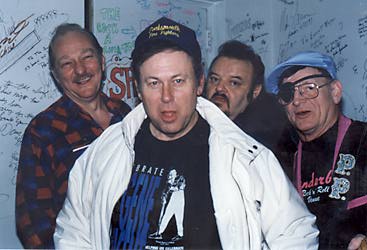
The Blue Caps will appear at the Eddie Cochran Weekend at Chippenham, UK on
Saturday 2nd October 1999.
Bobby Cochran and
Marco DiMaggio and other will also appear
If you would like to write to original drummer
Dickie Harrell, his address is 4113 Raven St., Portsmouth, VA 23702. Dickie is retired now (from his real job), loves
getting fan mail, and has the time to answer your letters. He'll even do radio interviews.
Maybe if he has extra time on his hands, he should start his own band on the side.
Why not suggest that to him and send him a band name idea that may spark him into action.
"Be-Bop" is too young to stop rockin'! Dickie is not on-line, but we'll see that he gets
all your e-mails.
Memphis turns out for Elvis Week
By
FETZER MILLS JR. - Some locals in Memphis call it "Dead Elvis Week," and it
was in full swing once again Saturday as thousands of Elvis Presley fans poured into town to mark the 22nd anniversary of the rock
and roll king's death.
Presley was found dead Aug. 16, 1977, at Graceland, the white-columned southern mansion that is the focal point for the celebration
officially called Elvis Week.
Throughout the week there are plenty of events officially sanctioned by Graceland or Elvis Presley Enterprises. Most of them are
musical tributes to Elvis but also include the Elvis Presley International 5K run.
"We at Graceland try to keep Elvis Week an upbeat celebration of Elvis's life, culminating in one solemn event, the candlelight vigil at
the gravesite on Sunday night," said Graceland spokesman Todd Anderson, who estimated 30,000 fans arrive in Memphis every year
for the festivities.
During the vigil, fans by the thousand walk past his grave next to Graceland through much of the night, carrying candles.
At the height of the week Elvis impersonators can be seen by the dozen, along with aging baby boomers in poodle skirts and Angora
sweaters.
Gail Elliot, 42, from Cannon, Ky., president of the Don't Be Cruel Elvis Fan Club, showed up wearing a poodle skirt, pink sweater,
saddle oxfords and bobby sox. She was at Graceland Crossing, a shopping center devoted to Elvis souvenirs. Nearby, Elvis
impersonators and a Dusty Springfield look-alike performed under a parking lot tent.
Elliot had just come from a sock hop at Humes High School, Presley's alma mater, where she won the dance contest.
"I was doing splits and cartwheels and everything," she said. She also said it was the second time she had attended Elvis Week, and
planned on being back every year. Nearby stood Johnny C, an Elvis impersonator from Las Vegas in black leather trousers and a
black, high-collared, long-sleeved shirt unbuttoned to the navel. A fan wandered by and asked to take his picture. He obliged by
slipping on his dark glasses and striking a familiar pose.
He said he gets gigs as Elvis four nights a week at two different casinos, Boulder Station and Texas Station. He is a craps dealer by
day at another casino.
"I recorded a song at Sun Studio today, and while I was in that room I could feel his presence. When I was on tour in the mansion
(Graceland), I could feel all of the love and joy that was Elvis," he said.
"I love it. I love all of the people. I'll be back next year."
Old Dogs Cut The Mustard
. . . with CMA Award Nomination. Bobby Bare, Waylon Jennings, Mel Tellis, and Jerry Reed
Are Named Final Nominees in Vocal Event Category.
Yes, Bobby Bare, Waylon Jennings, Mel Tillis, and Jerry Reed are thrilled with their
final nomination for the Vocal Event of the Year CMA Award. "Yeah," said Bare, "it's been so long since we've
been nominated for anything that we thought it was over. Of course, if we don't win, Waylon says he's gonna
blow up the building!"
Last year, the four artists collaborated on Old Dogs an Atlantic Records release that has since become
a staple of morning radio. Produced by Bare with all songs written by the late Shel Silverstein, the album is
an irreverent, semi-lewd, poignant, satiric commentary on the aging process.
Popular cuts like the current single "Still Gonna Die," as well as "Cut The Mustard" (I ain't too old to cut the
mustard, I'm just too tired to spread it around), "Elvis Has Left the Building" (and all you've got left is me),
"Rough On The Living" (Nashville is rough on the living but she really speaks well of the dead)," "She'd
Rather Be Homeless" (than here at home with me), and "Time" propelled the album into the Americana Top Ten.
Old Dogs appearances on TNN's "Prime Time Country" ignited sales and garnered the program it's best ratings
in recent memory. Initially sold as a two-record set through telemarketing, the single-volume retail CD arrived
in stores in December 1998.
Paul McCartney's Annual Buddy Holly
Tribute Comes to America
The Crickets with Nanci Griffith, Big Sandy & His Fly-Rite Boys,
Bobby Vee & The Vees To Perform At Finals Of Nationwide Buddy Holly
Rock 'N Roller Dance Contest To Take Place At New York's Roseland Ballroom.
nbsp; nbsp;
Paul McCartney is set to pay tribute to one of the greatest voices of rock n' roll on Tuesday,
September 7th, when the Roseland Ballroom plays host to The Buddy Holly Rock `N Roller Dance Party and contest finals.
Invitation-only guests, VIP's, fans and industry luminaries will be on hand, as well as a panel of celebrity judges that
will select a Grand Prize Winner and two runner-ups, taken from six couples, semi-finalists from the nationwide search
currently being held. The evening will also feature performances from The Crickets with special guest, Nanci Griffith, Big
Sandy & His Fly-Rite Boys and Bobby Vee & The Vees.
nbsp; nbsp;
"Buddy's music and memory are alive and timeless," said Maria Elena Holly. "His fans have always been very loyal and for
that he's been blessed; I will always be grateful for their love. Sir Paul has always been very supportive of Buddy's music
and legacy. He has been instrumental in keeping Buddy's music alive throughout the world. I'm personally grateful to him
for his continued dedication.Tribute Comes to America."
nbsp; nbsp;
One Grand Prize of $5,000 cash OR the choice of a trip to visit Rock 'N Roll Landmarks of the U.S., the 42nd Annual Grammy
Awards, Rollerblading on the Great Wall of China OR a Magical Mystery Tour package will be at stake. The second place
runner-up will receive $1,000 in cash and the third place runner-up will fetch $500.00 cash.
WCBS-FM's "Cousin Brucie" Morrow will host the evening festivities, which will be broadcast live on WCBS-FM 101.1,
New York's Oldies Station and via the World Wide Web by LiveOnTheNet.com, Inc. at http://www.liveonthenet.com -
For more information on this event, visit:
http://buddyholly.warpradio.com OR http://mplcommunications.com/buddy.
Jody Chastain Dies at Age 66
Billy Poore (close friend of the late Charlie Feathers) is sad to report that Jody Chastain, upright bass player
on most of Charlie Feathers 1950's classic Rockabilly recordings on the Meteor and King record labels passed away on July
28, 1999 at his home near Paris, TN. His funeral was held on July 31, 1999 in Paris, TN according to Wanda VanZant
(Charlie Feathers daughter). His cause of death was attributed to both Diabetes and Heart disease.
Between 56' and 58' Jody not only played bass on Feather's most memorable Rockabilly songs such as "Tongue Tied Jill",
"Get With It", "One Hand Loose", "Bottle To The Baby", "Everybody's Lovin' My Baby", "Jungle Fever", "Nobody's Woman"
and others but he also shared co-writer credit along with Charlie and lead guitarist Jerry Huffman on these records.
Jody also toured with Charlie and Jerry in Charlie feathers band at the time called "Charlie feathers and His Musical
Warriors". During the early 90's Norton Records released a 4 song vinyl E.P. that included 4 songs that Jody played
on with Charlie in 58' . At the time it was released on the Kay Record label. One song was titled "Diode's Beat"
which was an instrumental. Charlie, Jody and Jerry all played on it...Jody Chastain will be remembered by Rockabilly
fans around the world as on of the Best Upright, Slappin' Rockabilly Bass players of that Golden Era of this Music.
Merle Haggard To Do Pay Per View
Country Music legend Merle Haggard will perform a live Pay Per View television special on October 2 at
8 p.m. EST from the Las Vegas Hilton. TBA TV will produce the three-hour special to be called Merle Haggard For the Record. The
show chronicles Haggard's legendary career and will include numerous special guest performers and
storytellers. Tickets for the event go on sale August 28. For ticket information call 800/222-5361.
Preceding the broadcast event is the August 24 release of the Country Music Hall of Famer's double-CD
set of hits, also titled Merle Haggard For The Record. The new album boasts 43 songs, including 31 of
Haggard's number one hits. Joining Haggard for selected duets on the collection are Willie Nelson,
Alabama, Brooks & Dunn and pop sensation Jewel. Recorded for TBA Records, the album is being
marketed and distributed by RCA Label Group.
Rounding out the pre- and post-concert activity will be a book tour to promote the long-anticipated
Tom Carter and published by HarperCollins, the memoir will be in bookstores September 22. Book
signings are being planned for Nashville, Atlanta, Cummings (GA), Jacksonville (FL), Raleigh (NC),
Dallas and Houston with specific dates yet to be announced.
Anita Carter Dead At 66
July 30, 1999 - Anita Carter, who played
stand-up bass and sang soprano as a member of the
country music group the Carter Family, has died at age
of 66, her manager Lou Robin said Friday.
Carter had been suffering from rheumatoid arthritis,
but the cause of her death was not immediately known,
said Robin. Carter's sister, June Carter Cash and her
husband Johnny Cash were with her when she died
Thursday.
A Maces Springs, Virginia, native, Carter joined the
family music group in 1938, which initially included
her mother Maybelle and her cousins. They were later
joined by Carter's sisters and guitarist Chet Atkins.
Carter's 1951 duets with singer Hank Snow, `"Bluebird
Island" and "Down the Trail of Achin' Hearts," were
Top 5 country hits.
The group became regular members of the Grand Ole Opry
in 1950, and toured with Elvis Presley in 1956 and
1957 and with Johnny Cash beginning in 1961.
Carter's death leaves her sister June Cash the sole
survivor of the second-generation Carter family.
Update on the "Shake Rattle & Roll" TV Movie
Gary Allan has been cast to play Eddie Cochran in "Shake, Rattle and
Roll: An American Love Story," a mini-series set to air on CBS during
November sweeps.
Allan, whose hits include "It Would Be You" and "Her Man'" recently
recorded vocals for a pivotal scene in the movie where Cochran
performs "Summertime Blues. " Allan begins shooting for the film in
Charlotte, N.C. in late August.
The movie depicts the growth of American music from 1955 to 1963 by
chronicling two teenage boys from rural America as they form a band
and experience the seminal rock and roll scene of the late '50's and
early '60's.
MCA Records will also release a film soundtrack, which will include
Allan and others cast in the film such as K-Ci & JoJo, Terence Trent
D'Arby and Blink-182.
Allan is currently on tour and recentlly finished recording his third
release and first for MCA Records, "Smoke Rings In The Dark." The
title track is the first single which just shipped to radio and
Country Music Television has put the video in Sneak Peak rotation -
five plays a day. Long time producer Mark Wright, and label president
Tony Brown co-produced the CD set for a January 2000 release.
Narvel Felts at the Eddie Bond Show
Eddie Bond's Country Club, Hwy. 57 West, Big Hill Pond, TN (1/2 mile east of Big Hill
Pond State Park) hosted a concert Saturday, July 31st
featuring Narvel Felts. Narvel and Eddie are both inductees of the Rockabilly Hall of Fame. Eddie also has a TV show that runs every Saturday on WHBQ (Fox 13), Memphis and every Saturday and
Sunday on WBBJ (Ch. 7 ABC) in Jackson, TN. For the radio listeners Eddie Bond can be heard live at the Eddie Bond
Country Club each Saturday on WMOD FM 96.7. Eddie's Club in Bill Hill Pond, TN is open to the public Thursday, Friday and
Saturday nights from 8pm to ??? Stop by, join the fun and listen to some good country, gospel, bluegrass, rockabilly and
music.
Greaseball '99: Rockin' On The Bay
August Ragone and Greaseball Productions will be presenting the fifth annual
"Greaseball '99: Rockin' On The Bay" at locations to be announced shortly!
Bands are already being signed, and those acts interested in the event
should send press-kits to: Greaseball '99, 1726 Divisadero, San Francisco,
Ca. 94115. Companies and organizations who are interested in sponsoring or
vending at the show, should also contact the above address. There will be
more information to follow, as our website is being overhauled, and the
booking process is in mid-swing. So, please stand by and wtch this page!
August Ragone, Greaseball HQ, San Francisco
Patsy Cline Duets Album Due Sept. 14.
Volume One of the Patsy Cline Duets, featuring legendary country music artist Cline and many
of today's country stars, will be released Sept. 14 courtesy of Private I/Mercury Records. The
album is the first of three planned volumes of duets and features both legendary and newer talent.
Willie Nelson, Glenn Campbell, Waylon Jennings, Crystal Gayle, Michelle Wright, Beth Neilsen
Chapman, Bob Carlisle, John Berry, and Mila Mason all team with Cline
on the album. Both Nelson and Jennings were contemporaries of
Cline, with Nelson penning Cline's most enduring classic, "Crazy."
The album's tracks were produced by weaving the contemporary
voices into the classic Cline recordings, ala Natalie Cole's hit duet,
"Unforgettable," featuring her departed father, Nat King Cole.
Producer Michael Blakey enlisted the help of a forensic scientist to
extract Cline's vocals from existing mono tracks and enhanced the
tracks by adding orchestration. The re-recording of the musical tracks
and the vocal recording of the duets took over a year-and-a-half to
complete. Both the artists who contributed to the duet as well as Cline's family
were unanimous in their praise of the pristine quality of the recording.

More "Live at Gilleys:"
JLL, Fats, Bobby Bare, etc.
Recorded "Live At Gilley's"
Four new albums recorded live at Gilley's, the legendary Pasadena,
Texas nightclub co-owned by country music star Mickey Gilley, will be released by Q Records to retail
locations everywhere on June 22 and August 3, 1999. The releases feature never-before available
performances recorded at the club during the 1980s by artists who played Gilley's: Fats Domino, the
Bellamy Brothers, Jerry Lee Lewis and Bobby Bare.
"Fats Domino Live At Gilley's and Bellamy Brothers Live At Gilley's" will be available June 22;
"Jerry Lee Lewis Live At Gilley's" and "Bobby Bare Live At Gilley's" will be available August 3. The
single-artist releases are a continuation of Q Records' Live At Gilley's series that includes
Carl Perkins Live At Gilley's, Johnny Paycheck Live At Gilley's and the initial boxed set Live At Gilley's
Volumes 1-4, which features 56 tracks by 27 top artists who played the club.
All the cuts on the Live At Gilley's series are culled from more than 900 hours of music recorded at the
24-track, state-of-the-art studio that broadcast Gilley's weekly nationally syndicated radio series "Live
From Gilley's," 1980-1988. Although the club burned down in 1989, the tapes of these historic performances
were saved and have been used to create the Q Records releases. Gilley's, designated the "world's largest
nightclub" by the Guinness Book of World Records, was the inspiration and location for the 1980 Paramount
Pictures film Urban Cowboy.
Each of the June 22 albums feature 12 tracks that will appeal to fans of R&B, rock 'n' roll and country
music. Fats Domino Live At Gilley's was recorded on March 6, 1981 and demonstrates his notable piano-playing
chops, rich singing drawl, and clever mix of cajun, country and R&B. Taped during one of Domino's non-touring
periods, the CD includes such top-10 hits as: "Blueberry Hill," "Shake, Rattle And Roll," "I'm Walkin',
"Blue Monday," "I'm In Love Again," and his very first hit, "The Fat Man."
Antoine "Fats" Domino was one of the first artists inducted into the Rock and Roll Hall Of Fame (1986) and
was awarded the 1998 National Medal Of Arts by President Clinton. Domino's latest public appearance was a
rare performance at the 1999 New Orleans Jazz And Heritage Festival.
"Bellamy Brothers Live At Gilley's documents their April 23, 1982 performance and showcases an inventive
blend of their country roots with the playful humor for which this duo is famous. Six of their top-5 hits
are on this release including "If I Said You Had A Beautiful Body Would You Hold It Against Me,"
"You Ain't Just Whistlin' Dixie," "Do You Love As Good As You Look," and "For All The Wrong Reasons."
Bellamy Brothers released more than 20 albums and many top country hits from 1976 - 1987. They received
more nominations for "Duo Of The Year" by the Country Music Association and the Academy Of Country Music than
any other pair in history. They currently divide their time between touring and working their 2,500-acre
cattle ranch. Since 1989 they've hosted the Snake, Rattle & Roll Jam benefit concert held annually in
San Antonio, TX.
The August 3 releases showcase early rock 'n' roll, country and folk music. "Jerry Lee Lewis Live At
Gilley's" combines two performances (August 26, 1984 and October 7, 1987) by one of the founding fathers of
rock 'n' roll. Lewis' Gilley's recording reveals his manic yet precise vocal style and his pumping piano
stylings. His biggest hits are captured on the 14-track release, including "Great Balls Of Fire," "Whole
Lotta Shakin' Goin' On," "Trouble In Mind," "High School Confidential" and "Rockin' My Life Away."
Jerry Lee Lewis, nicknamed "The Killer," is Mickey Gilley's first cousin and is known primarily as
one of the founding fathers of rock 'n' roll. In 1986 he was inducted into the Rock And Roll Hall Of Fame.
Three years later, his life was documented in the film Great Balls Of Fire, starring Dennis Quaid as Lewis.
He is currently on a summer US tour.
Recorded on April 5, 1994, "Bobby Bare Live At Gilley's appeals to both country and folk music fans. The
CD reveals the sense of humor, sensitivity, and clever storytelling for which Bare is internationally
recognized. Five of the 12 tracks on this release are top-10 country hits, such as "Marie Laveau," "Come
Sundown," "Four Strong Winds" and his 1963 Grammy Award winner "Detroit City."
Bobby Bare is known to millions for hosting TNN's "Bobby Bare And Friends" and for his role in the film
A distant Trumpet. He is currently releasing new albums and is touring with the band "Old Dogs," which
also includes Waylon Jennings, Mel Tillis and Jerry Reed.
All Q Records' Live At Gilley's recordings are distributed to retail by The Atlantic Recording Company
via WEA Corporation. The catalog numbers are: Bellamy Brothers (92832), Fats Domino (982833), Jerry Lee
Lewis (92835), and Bobby Bare (92836). The label plans to issue additional Live At Gilley's releases.

The Comets Record at Rollin' Rock Studio
Las Vegas, NV - Ronnie Weiser announced that
he has recorded original Comets at Rollin' Rock Records.
They played on "Rock Around The Clock", the biggest selling rock'n'roll
record of all time.
This CD will available at all Comet live shows
once it's pressed and packaged.
Modern Twang
 The Chicago Tribune may have said it best when it said "If you think of country music
as big hair, big hats, and slick production, then clearly, you've missed out on the alternative country
revolution."
The Chicago Tribune may have said it best when it said "If you think of country music
as big hair, big hats, and slick production, then clearly, you've missed out on the alternative country
revolution."
Now, thanks to author David Goodman, the alternative country revolution has its own reference book,
Modern Twang: An Alternative Country Music Guide and Directory (Dowling Press, $22.00). Modern Twang is
464 pages of all things alt.country. Author David Goodman defines the movement as an "umbrella term for
a wide array of performers from the late 1960s to the present, who, generally working outside of the
Nashville country mainstream, have reinterpreted and enhanced traditional country music styles and themes
by incorporating a variety of modern musical and non-musical influences."
Modern Twang: An Alternative Country Music Guide and Directory, the only source book dedicated to the
alternative country movement, is divided into ten sections: over 600 alternative country artists A-Z;
terms; compilations/soundtracks; record industry resources and labels; print and online publications;
WWW pages; online mailing lists; venues -- US and international; festivals and other annual events; and
radio and television outlets devoted to alt.country.
Goodman is available for interview in conjunction with the release of Modern Twang. Dowling Press
is an independent publisher of nonfiction music books located in Nashville, Tennessee. To request a
review copy, please contact Maryglenn by phone (615) 340-0967, or by email, mrygln@aol.com
DAVID GOODMAN AUTHOR OF MODERN TWANG
What do the internet, the soundtrack to The Music Man, and a grandmother have in common? For David Goodman,
a combination of the three led to his first book, Modern Twang: An Alternative Country Music Guide and
Directory (Dowling Press, $22.00). Goodman, born (1952) and raised in Dallas, Texas, describes a collection
of 78 rpm records, given to him by his grandmother, as his first real record collection. "These records
were like an overview of Americana - country, blues, jazz. I was never quite sure where, how, or why my
grandmother had acquired them."
These records became Goodman's escape. His father, a devotee of The Music Man soundtrack, had a bizarre
affinity for playing the record loud and early - ("76 Trombones' every morning at six," Goodman recalls.)
What Goodman didn't realize at the time was that this set of circumstances was leading up to something.
Goodman, who did graduate work in History and American Studies at Carnegie Mellon and the University of
New Mexico, realized a life long dream in 1993 when he moved to Austin, Texas. "I had been going there
for years for the music. I went with the idea of finishing my dissertation," he recalls. "But," he readily
admits, "it was really more for the music."
While in Austin, Goodman worked as a full-time substitute teacher in Austin's public school. "I led
two lives. I was teacher by day, out honky tonk dancing every night." (Goodman's dancing even earned
him the "most unique dance style award" from Floorplay magazine in 1999.) Goodman recalls that 1994 was
the year when the term "alternative country" began to appear widely in print. "I remember reading articles
about groups such as the Jayhawks and Uncle Tupelo. I became fascinated when I realized that these bands
were influenced by the same music I'd been listening to since high school." So, he made lists. The lists
grew, and Goodman soon realized that alternative country was a separate genre with its own history deserving
of a guide and directory. Modern Twang was born and began to take shape.
Enter the Internet. Goodman researched from 1994 through 1997. "Modern Twang would have been impossible
without the Internet. The growth of the Internet was paralleled by the growth of alternative country.
While I was researching, it became evident that alternative country is a global community which I wanted
to be able to link up." Goodman began the writing process in 1997, and in March, 1998, self-published
Modern Twang: An Alternative Country Music Guide and Directory, which has since been updated, expanded
and recently published by Dowling Press in Nashville.
So, why did he do it? "I feel a tremendous debt to these musicians and feel that Modern Twang is an
opportunity to give something back." David Goodman lives in Lancaster, Pennsylvania, with his wife, Jane
and two cats, Nicky and the Little Boy. For information, please contact Maryglenn at phone: (615) 340-0967
or email: mrygln@aol.com


Guy Mitchell Dead at Age 72
LAS VEGAS - July 2, 1999 -
Guy Mitchell, a country-pop artist from the 1950s whose
recordings of "Singing the Blues" and "Heartaches by the Number" skyrocketed
to the top of the charts and became standards of the era, died Thursday. He was 72.
Guy's real name was Al Cernik. Channel 3 TV in Las Vegas reports the death of Guy
was after surgery at Desert Springs Hospital.
MINI BIO: Guy Mitchell was born Al Cernick on February 27, 1927 in Detroit, Michigan. When Guy was 11 years old
the family moved to Los Angeles. On the train journey to Los Angeles a passenger told Guy's mother that
her son had a beautiful voice and when they got settled in Los Angeles she should contact him. True to his
word, he arranged an audition with Warner Brothers who signed Guy to a contract for grooming as a child
star. He took acting, dancing, voice, and diction lessons, and sang on the studios radio station. Country
singer Dude Martin invited Guy to appear regularly on his two radio shows.
In 1947 Guy joined Carmen Cavallaro's orchestra as a vocalist and made his first recording for Decca
Records. In 1949 Guy was a winner on the....Arthur Godfrey talent Scouts. In 1948 he recorded two songs
with Mitch Miller for Columbia Records.....My Heart Cries For You and The Roving Kind. Both songs made the
top five on the charts.
Guy's first number one hit....Singing The Blues....came in 1956 and was the first of six singles in the
rock era to have a nine week run at number one. Elvis Presley's....Too Much....ended the nine week streak. In
1959 Guy had his second number one hit....Heartaches By The Number.
He pursued dual careers during the fifties and sixties. All the time he was having hits on the charts, he
was also working full time as an actor. He made movies with Teresa Brewer and Rosemary Clooney to name
a few. He also had his own television show in 1957.
Mitchell made three tours of England. In 1952, he filled in for Jack Benny at the London Palladium. Two years
later he was invited, along with Frankie Lane, to sing for Queen Elizabeth II and had his own one-hour
British TV special.
A good example of Guy's recordings from the '50's can be found on the
Columbia mid-price CD: "The Best Of Guy Mitchell" -
Singing The Blues: The Roving Kind: Cuff Of My Shirt: She Wears Red
Feathers: Chicka Boom: Belle, Belle my Liberty Belle: Rock-A-Billy: My
Truly, Truly Fair: Feet Up (Pat Him On The Po-Po): Look At That Girl:
Sparrow On The Treetops: My Heart Cries For You: Pittsburgh
Pennsylvania: There's Always Room At My House: Crazy With Love: Cloud
Lucky Seven: Dime And A Dollar: Heartaches By The Number: Knee Deep In
The Blues: Christopher Columbus: Pretty Little Black Eyed Susie:Sippin'
Soda: The Day Of Jubilo: Call Rosie On The Phone.
Barry Klein Reviews Indy 1999
Young Johnny Cash Mini-Movie Draws Interest
I Still Miss Someone, an acclaimed, Nashville-produced, 17-minute film starring
singer/songwriter Mark Collie as a young Johnny Cash, is creating a frenzy of interest
from Hollywood. The short film noir won two top honors at a
recent Nashville film festival. The film's intensity, stark images, and Collie's stunning
portrayal combine into a powerful piece of Nashville artistry. Amazingly, I Still Miss
Someone was shot in 2 1/2 days and edited in less than a week.
Written by Collie and director John Lloyd Miller, the
piece was originally intended as a screentest for Collie,
who wants the role of Cash in an upcoming Hollywood
feature. "We made this with the intention of showing it
only to John and June (Cash) and the feature director,"
says Miller. "To have it get so much attention is a shock."
In addition to the local lauds, the film has been requested
for viewing by talent agencies, major film studios and
numerous production companies‹including those of
Oprah Winfrey and Roberto Benigni. Offers for work
on features films and television movies have been
pouring in. Collie credits the film's success to a team effort. "David
Gossard, the director of photography, is just brilliant,"
he says. "Randy Scruggs and Harry Stinson were
incredible in putting the music together. Everybody
brought something to the party, mostly passion."
First Ever Elvis Archival Memorabilia Auction
Collector PLC is pleased to announce that the company has been
awarded the on-line contract from Guernsey's, one of the most prestigious New York
based auction houses, to host the first ever auction of Elvis Presley
archival memorabilia from The Graceland's Estate. It is the first time
ever, significant archival material relating to the career of Elvis Presley
will be made available to the public through an auction being held on behalf
of Elvis Presley Enterprises (EPE). Approximately 2,000 lots from
Graceland's archives will be featured in the sale, including cars, clothes
and furniture in addition to a staggering array of important documents
relating to the career of the "King of Rock 'N Roll".
icollector will host the catalogue on line at www.icollector.com, enabling
Elvis fans to place bids via e-mail prior to the auction. Guernsey's, the
record setting auction house that recently conducted the President John F.
Kennedy auction and astounding baseball sale that included Mark
McGuire's $3 million dollar ball, will then host the live auction to take place at the
MGM Grand Hotel in Las Vegas, in early October 1999. Bids will not only be
taken by the traditional method, but will also be conducted via absentee
bidding in every conceivable form including the internet. "It is a great honour to be associated with
and partnering one of the most prestigious auction houses in the world, Guernsey's, in what is
probably the most exciting memorabilia sale of the decade. This is the strongest
possible endorsement of icollector's business to consumer e-commerce
strategy on the internet." said James Corsellis, CEO of icollector plcItems
in the auction include original contracts and correspondence signed by
Elvis, Colonel Parker, Sam Phillips (Sun Records), RCA and other key
individuals and organisations, tracing a career that started in childhood in
Tupelo (Mississippi) and meteorically rose through Memphis to a worldwide
stage. Every item in this auction will be accompanied by a certification
indicating that these items are from the Presley estate.
The primary goal of the auction is to establish a building fund for the
creation of Presley Place, a transitional housing development in Memphis.
icollector plc trades on the OFEX facility in London, to visit the
website go to http://www.icollector.com
Sun Records Goes Digital on Masters for Net Sales
Nashville, Tennesse-based Sun Entertainment Holding Corporation has
announced that the digital transfer of 7,400 Sun Records master
recordings has been completed.
Sun is in the process of transfering its master recordings from analogue
to digital in anticipation of online music sales and distribution
becoming a major part of music retailing. The company estimates that
more than 1,000 masters remain to be transferred.
The corporation has the exclusive worldwide rights to manufacture and
distribute recordings by artists such as Johnny Cash, Roy Orbison, Elvis
Presley and Carl Perkins as contained on Sun Records masters.
The company went online with its own website in January of this year,
and has since moved to expand its online presence and earnings through
deals with major online retailers and custom CD companies. Sun says that
it has completely revised its business plan in light of the online
developments, and has submitted its new plan to several investment
firms.
Music Festival Can't Mention Buddy Holly
Singer's widow, Lubbock fail to reach agreement
Since singer Buddy Holly's death, his family and wife have fought
repeatedly for licensing control and royalties. Now, even the annual music
festival in his hometown is embroiled in a dispute over efforts to
capitalize on Holly's fame. Widow Maria Elena Holly has rejected the city's
offer of $50,000 and 15 percent of the profits for permission to use the
singer's name and likeness in connection with the festival. City officials
said she wants more money. Mrs. Holly declined to say why she didn't accept
the city's offer and blames officials for the breakdown in negotiations.
"I'm not going to get into the controversy," Mrs. Holly said from her Dallas
home. "I'm tired of being used as a scapegoat for people who can't do their
job. I am tired of city officials who don't know how to put a festival
together saying bad things about me." The city has decided to rename the
event the West Texas Rock 'n' Roll Festival. The festival, which has been
held annually for three years under the Holly name and several years off and
on before that, is scheduled for the weekend of Sept. 4. Mrs. Holly has
threatened to sue the city if it holds the festival that weekend, even using
the new name, because she says it still will profit from the proximity to
Holly's birthday, Sept. 7, 1936. Lubbock City Council member Alex Cooke said
renaming the event is unfortunate. "It's a shame that we couldn't get
something worked out to further promote Buddy Holly in his hometown," he
said. "My thought was that what we needed was a long-term contract so we
wouldn't have to go through this with Mrs. Holly every year, but apparently
we couldn't do it. We have a festival in September, and we were still trying
to negotiate a contract in June. That was unacceptable." Buddy Holly became
Lubbock's most famous son after he brought his unique blend of country,
gospel, rhythm and blues, and pop from a studio in nearby Clovis, N.M., to
the world. His songs, several of which became American anthems, include
That'll Be the Day and Peggy Sue. He was killed in a Feb. 3, 1959, plane
crash that also took the lives of rock legends Ritchie Valens and J.P. "The
Big Bopper" Richardson. Bobby Vee, a contemporary of Mr. Holly's who sang
the hit Rubberball, said the fighting over the Holly name is detracting from
the singer's legacy. "It's a huge shame," he said. "This is Lubbock, Texas.
This is Buddy Holly's hometown. Those people deserve to be able to celebrate
his memory."

Photo by Libby C. Rhodes
After 45 years of performing, Johnny Meeks is retiring and once again will call Laurens
home. The musician is not certain what retirement will be like, but he
"thinks he will enjoy it."
Johnny Meeks' Career Comes Full Circle
Johnny Meeks sang and played his first song on his hometown radio station WLBG in the 1950s. "It (the radio
show) was Bashful Henry's Saturday Afternoon Jamboree." Meeks said. "Henry allowed local talent to perform and I
think my first song was an old Ray Price Tune, "Please Release Me."
Meeks' first guitar was a gift on his 15th birthday. "It was a silvertone and came with an instruction book.
I taught myself how to play by studying the book and listening to the radio," he said. Soon after his WLBG appearance
Meeks played guitar at Floyd's Barn in Fountain Inn. Later he joined Country Earl and The Circle E Ranch Gang of
Greenville and then signed with Gene Vincent's Blue Caps.
While with the Blue Caps Johnny performed on "The Ozark Jubilee" with "Red" Foley and the Ed Sullivan Show, as
well as appearing in the movie "Hot Rod Gang." The band toured all the major cities of Canada and four different times,
did a two week tour of Australia and performed in 45 states. After parting with Gene Vincent and his band, Meeks worked
night clubs in the Los Angeles area, including the Palomino, with his own band the Tune
Toppers. Meeks performed with Ricky Nelson and Michael Nesmith and was a member of Merle Haggard's band. While with Haggard,
he performed at the Country Music Awards Show in Nashville. He also filmed two songs with Elvis Presley in the movie,
"Roustabout." After 45 years of performing, Johnny Meeks is retiring and once again will call Laurens home. "I won't officially
retire until May," Meeks said. "I only have one more tour in sight. I will perform at a music festival in England, a
reunion of the Blue Caps." Meeks is not certain what retirement will be like but thinks he will enjoy it.
"I'll still play music. I just won't be on the road," he said. Meeks will perform on Friday and Saturday at 5 pm on the
first weekend of each month at M & M Auction on Fairview Road for his old friend Floyd Morton. "This won't be like a job.
Playing at Floyd's will be for fun," Meeks said." I guess. "I guess you could say I have come full circle because Floyd
gave me my first job back in the 50's." -By Libby C. Rhodes - For The Advitiser
ED. NOTE: Johnny once told Bob Timmers, "I may retire someday, but I'll always a Blue Cap until I die!"
Good news for all Caps fans.

Rimshots Roll On Into 2000
1999 has been a year that
The Rimshots have gone from strength to strength.
Their ever-growing audiences have enjoyed their unique blend of County
Rockabilly with some Roll. So much so that their latest album, A Tribute to
Hank Williams, a joint venture with Rusti Steel and the Tin Tax has lead to
new opportunities. So impressed was Van Morrisson by the original sound of the Hank Williams
Tribute Album, he recruited the Rimshots talents for a day in the studio. In
all it turned into five days and 22 songs recorded. Of these fifteen have
been chosen for a future album. The Hank Williams Tribute Album was also awarded the title of
'The Best
British Country Album of the year'. Awarded by the British Country Music
Awards, a panel made up of 150 industry professionals.
The never-ending touring dates are still continuing with an increase of
festivals such as:
The "Three Of a Kind" Festival in Berlin -
North Wales Theatre, Country Weekend, Llandudno -
Headlining Festival Ons Huis, Belgium.
Last year The Rimshots played in no fewer than fourteen countries. They have
been asked to add Australia to the list in the early part of 2000, due to a
large following in Perth and Melbourne.
On many occasions the band has not only performed their own powerful set but
have also backed other artists such as: -
Narvel Felts (Who has had over 60 chart hits, including a No. 1 In the USA)
at the Americana, Jacksonville and Hemsby. Which if you missed the
performances last year, you could have been lucky to get the chance again in
May for they were booked back due to popular demand.
Mac Curtis, who they have also recorded with, joined forces with them again
in Rotherham last May.
THE RIMSHOTS WOULD LIKE TO TAKE THIS OPPORTUNITY TO THANK EVERYONE WHO HAS
SUPPORTED THEM THROUGHOUT THE YEARS.

Danny Gatton with Robert Gordon Live CD
Renegade Records has issued a Limited Collector's Edition of a Robert Gordon and
Danny Gatton Live CD, "Capitol Attack."
>Only 500 copies of the "Capitol Attack" live CD by Robert Gordon and Danny Gatton have
been pressed by Renegade. These CD's are only available from Renegade Records to fans
now and will not be available anywhere else. The reason this CD is titled "Capitol
Attack" is because it was the final time Danny was on stage in Washington, D.C. with
Robert Gordon. The entire show is on this disk. The liner notes are excellent.
It is now avaialble as a one-time offer to fans of Danny
Gatton's incredible guitar work - a chance to own a true collector's item. There
will not be any future pressings. Because of the advance demand for this highly
anticipated CD release there is a three CD limit per order.
Only money orders, cashier checks or I.M.O.'s (U.S.
currency) accepted. $25.00 per copy (includes postage in U.S.) $30.00 per copy
(includes postage anywhere in the world). Make
payable to: Renegade Records, Route 4, Box 161-Al, Linden, TN 37096.
For complete information and 20
songtrack listing visit the
Renegade Records website or E-mail: renegade@netease.net
Jerry Reed OK after Heart Surgery
NASHVILLE, Tenn. (June 6, 1999) - Singer-actor Jerry Reed, best
known for his role in the "Smokey and the Bandit" movies,
spent the weekend in intensive care recovering from
quadruple heart bypass surgery.
Reed, 62, was in critical but stable condition Saturday
evening following Thursday's open heart surgery, said Baptist Hospital
spokeswoman Melissa Ausbrook.
Reed, who previously had two angioplasty procedures to open clogged blood
vessels, told his doctor Wednesday he felt chest pains.
"The doctor told him not to leave the hospital because he thought he'd have a
heart attack," Reed's booking agent Carrie Moore told The Tennessean. Reed is
expected to remain hospitalized about a week and he'll stay off the road for some
six weeks after that.
Jerry wrote "Crazy Legs" for Gene Vincent and once claimed it was the
worst song he had ever penned.
The Atlanta native gained fame with songs like "When You're Hot, You're Hot," a
No. 1 country tune in 1972 that reached No. 9 on the pop charts.
He also played good ol' boys in several films, most notably the truck driver in the
"Smokey and the Bandit" series starring Burt Reynolds. Reed played a mean
football coach in the 1998 film "The Waterboy."

Modern Lounge Mag Features Rockabilly
Modern Lounge
magazine's second issue features a nice spread on "Rockabilly Style."
The colorful publication covers a variety of rockabilly/swing subject including:
the pin-up history, vintage cadillacs, the world of shag, retro movie reviews,
CD reviews, Marilyn Monroe make-over tips, and much more. For information, contact:
Modern Lounge,
1405 N. Mansfield Ave., Los Angeles, CA 90028. E-mail: steen@modernlounge.com OR
eyegrieve@modernlounge.com
REVIEW: Dave Crimmen's "Where He Left Off"
PRIMAL ROCKABILLY AT ITS BEST!
Dave Crimmen's C.D. "Where He Left Off" is an unexpected "tidal wave"
of primal rockabilly. The first cut, "Take Me Baby" is an earth-shaker!
Crimmen wrote all the tunes which are incredibly fresh including the amazing
"She Can't Stop Dancing!". Every cut deserves repeat listening. And hey, the
newness just won't wear off as Dave and his jamming band takes you on a music
trip--the likes of which have not been heard since Scotty, Bill & DJ! (And I
was there!)
Dave Crimmen is a maximizer of R&R; and every true Rockabilly music fan who
loves Vincent, Orbison, Elvis, etc...will flip over this eye-widening, "go
Kat go" 90's version of rockabilly to perfection! I won't fail to mention the
astounding producer, Michael Molenda, along with band members, Patrick Walker
on wild drums, Harry Mello on radical piano, Mike Bazlamit on swinging sax
and Bill Shaffer on real-gone bass. You guys brought the days of "rockabilly
heaven" back "real good"! My personal thanks!
--Kay Wheeler
London Rockabilly HOF Store
Location: Collectors Centre, 98 Wood Street, Walthamstow,
London, E17 ENGLAND, Opening Hours: Mon, Tues, Wed, Fri & Sat.,
10:00 am - 5.00 pm. Please see
more information and then stop by when in the area. Thank you.
Rockabilly HOF Has Discussion Group
Many of the artists (both legendary and newer) continue to e-mail the
Rockabilly Hall of Fame on a regular basis. They desire to communicate
with each other and the fans. Thus: the creation of
The ROCKABILLY HALL OF FAME E-mail Discussion List
Click to subscribe.
Please use this list wisely and stick to the subject of
rockabilly and early rock music and related happenings. Archives will soon be located at:
Rab-HoF Archives.


Rockabilly HoF Releases 6th CD: Bobby Lowell
Bobby Lowell and the Rocka Boogie Boys, from Lincoln, Nebraska, are featured on
6th CD released on the Rockabilly Hall of Fame label within the past 14 months.
Bobby's "Rocka Boogie/Rock Billy: Just Won't Stop!" 13-track CD offers another
side to rockabilly music. These cuts were recorded to prove that a more laid back
rockin' sound works just as well as the wild, frenzied approach. Just as
Billy Lee Riley's "Hot Damn", Bobby Lowell's disk is one you can listen to
anytime and get a sweet rockin' sound - a refreshing break without losing the
music genre. Bobby's CD is available at the Rockabilly Hall of Fame office,
$15 each, includes postage.
Order direct from:
Rockabilly Hall of Fame
P.O. Box 70
Kimberly, WI 54136
Johnny Cash, Willie Nelson In Heritage Series
Also, Cash Compilations Coming Sept. 14.
Classic country fans rejoice: Aug. 17 marks the release of Legacy
Recordings/ Sony Nashville's latest offering,
the Heritage Series. Kicking off the reissue
series will be five archetypal country albums,
all remastered expanded editions, which feature
several as- yet- undecided bonus tracks and additional liner notes. Johnny Cash's
1968 live album, At Folsom Prison, Willie Nelson's 1978
album, Stardust, Merle Haggard's 1981 Epic Records debut,
Big City, Marty Robbins' 1995 album, Gunfighter Ballads,
and Tammy Wynette's 1968 classic, Stand By Your Man,
will all be put through the ringer for the series.
Legacy Recordings is currently putting together the
second installment of the Heritage Series, tentatively
scheduled for a spring 2000 release.
In related news, Legacy Recordings/ Sony Nashville will
also be releasing three brand-new Cash compilations on Sept.
14 -- Love Songs, Murder Ballads, and Sings Songs of
Inspiration. Cash himself was involved with the sequencing
on all three albums.
Rock Around the Clock Named Greatest Single Ever
...beats The Beatles.
The Daily Express of Britain reports that Bill Haley and the Comets'
45-year-old classic, Rock Around the Clock, has been named the greatest
single of all time in the new edition of the Guinness Book of Hit
Singles.
According to the Express, Clock beat out Queen's Bohemian Rhapsody for
the top honors.
Apparently, the placement is chosen based not just on sales performance
-- Clock sold an estimated 25 million copies -- but also on popularity
and British chart performance. The Haley classic was a hit on five
separate occasions after its release on Decca Records in 1954.
By comparison, the Express reports, the biggest selling pop song of all
time, Elton John's Candle in the Wind, could only muster 64th place in
the ratings. It may have sold 33 million copies, the article says, but
it was only a hit once and popular only for a short length of time.
The highest placing by The Beatles is She Loves You at No. 19, while the
only song from the 1990s to make the top 10 was Canadian Bryan Adams'
ballad Everything I Do I Do it for You, which stayed at No. 1 on the
charts for 16 weeks.
The Express article concludes that, while the placement of many titles
in the list is bound to cause controversy -- such as the location of the
Beatles so low on the list -- few are likely to argue with Rock Around
the Clock holding the No. 1 spot.
Submitted by Alex Frazer-Harrison (www.rockabillyhall.com/Extra.html)
Music Kings Offers DiMaggio Bros. Downloads
Roy McBrayer has announced that
MUSIC KINGS is working with the Rockabilly Hall
of Fame site, www.rockabillyhall.com, and the they have just posted the DiMaggio brothers (CD and
downloadable songs) from the the HOF label. Music King is playing the DiMaggio
Brothers on our Windows Media stream You have to have the latest Windows
Media Player (beta) which is available from a link at our site and it is
free. The site address is http://www.musickings.com
The DiMaggio Brothers are from Italy but you couldn't tell they weren't from
the U.S. Their bass player's aggressive style on this CD reminds me alot of
Kevin Smith from High Noon. A couple of their song choices are unusual such
as the song "Every Breath You Take" originally by the Police. But their
interpretations are interesting. I like the bassist's work in fitting into
songs that I wouldn't think would work with a slap bass. They do a good job
giving the Rockabilly sound to material that I wouldn't think would fit the
style.
REVIEW: "My Day in the 'SUN'"
By Rockabilly Hall of Fame correspondent - Steve Lester.
This cat had an incredible day in the "Sun" this past Saturday, May the
8th in the rockabilly Mecca of Memphis, TN. I rendezvoused there with many
of my friends including Tommie Wix (Wix Records), my fellow Paducahan and Wix
recording artist Wayne Keeling and another Wix artist Wayne Worley ("Red
Headed Woman" -- look under "W" on the RABHOF inductees list) and his lovely
wife Angie. We managed to start the day off right with a little hotel room
get together where we managed to get Mr. Worley to show off his vintage Strat
and pick and sing a little bit. Wayne certainly can still pick and sing like
a champion!
From there we made our way to 706 Union Avenue where we met up with the
still lovely Ms. Barbara Pittman. Barbara talked just a little about her
upcoming recording project (see the RABHOF front page) and also about old
times -- like how she used to hang out with Elvis at the cafe next door to
Sun Studio and shoot the breeze. "I would sit here and Elvis would sit right
there where you're sitting now" she said. You won't hear that statement from
too many people who are actually telling the truth when they say it!
Soon the one and only J. M. Van Eaton dropped by to say "Hello" and get
in the mood for the evening's performance -- the Sun Records tribute at the
Beale Street Music Festival, part of the "Memphis in May" festival which just
gets bigger and better every year. Then J. M. lead us off to "Denny's" for
some eats and more rock and roll conversation.
Then it was back to Sun where we waited for the other performers which
made up "Billy Lee Riley and the Sun All-Stars." One by one they each showed
up with smiles, handshakes and eager anticipation of the night's gig.
Smoochie Smith, Sonny Burgess, Paul Burlison and then Billy Lee Riley -
gentlemen every one.
On to the banks of the mighty Mississippi where gear was unloaded and
setup for the show. I had the rare privilege of getting a backstage view of
a night to remember unfolding. In the VIP trailer there were plenty of
stories told and naturally lots of guitar talk. I also had the pleasure of
meeting a couple of members of a fantastic Memphis based band - The Dempseys
(Brad Birkedahl - guitar and Joe Fick - stand up bass) two very nice (and
talented) individuals.
The only "downer" was the unfortunate news that Malcolm Yelvington had
just days before suffered a broken collar bone and would not be able to
perform in his scheduled slot just in front of the "Sun All-Stars."
And then -- the show. The complete lineup was as follows: Billy Lee
Riley (harmonica, vocals), Sonny Burgess (guitar, vocals), Paul Burlison
(guitar), Smoochie Smith (piano, vocals), J. M. Van Eaton (drums, vocals) and
two members of Billy Lee Riley's current band rounded it out - Rob Mayberry
on guitar and Barry Shaw on bass.
Just a few hundred yards down the river bank, Hootie and the Blowfish
were performing. It will come as no surprise to those reading this who had
the bigger crowd - BUT, if you are reading this then you know damn well which
crowd got the better show!!! The crowd, I might add, was a very interesting
melting pot representing all ages, races, creeds and dispositions. (and
there was plenty of dancing, for to stand still was simply not possible).
Here is a blow by blow, song by song recap of the event.
1) "Dust My Broom" - a great way to start and a good way for everybody to
show off equally and make for damn sure everybody was paying attention!
2 & 3) "We Wanna Boogie" and "T for Texas" - Sonny Burgess, looking right
surly in a denim shirt, a black beret and some fine lookin' shades got the
night started out right.
4 & 5) "Rock With Me Baby" and "Flying Saucer Rock and Roll" - Vintage Billy
Lee Riley, what else can I say?
6) "Let it Rock" - Smoochie Smith gave this Chuck Berry number a fine
keyboard abusing workout!
7 & 8) "Train Kept a Rollin'" and "Tear It Up" - Paul Burlison took center
stage for these Rock and Roll Trio classics and was in fine form. I'd like
to add that Brad Birkedahl of the Dempseys got a guest appearance on the
stage at this point and took full advantage. Brad added a very youthful and
exuberant touch and played hotter than the hood of a black 55 Ford after a
long drive through the desert!
9) "Pearly Lee" - Back to Mr. Riley for one of the all time great Sun rockers.
10) "Memphis In '55" - J. M Van Eaton not only pounded, but also sang the
hell out of this self-penned number which is the lead off track of his solo
CD entitled "The Beat Goes On." If you ain't got it yet, you need to get it!
11) "Farmer's Blues" - A fine Sonny Burgess number. I was not familiar with
this one before the show, but it didn't take me long to add it to my "must
have" list.
12) "Trouble Bound" - back to the master - Billy Lee Riley - for this fine
rockin' blues number.
13) "Red Headed Woman" - Sonny Burgess was truly in fine form yall.
14) "Red Hot" - Much of the crowd was anxiously awaiting this treat from
Billy Lee (and rightfully so!)
15) The finale was a totally hot medley including "Whole Lotta Shakin'",
"Gone Gone Gone", "Tutti Frutti", "Shake Rattle and Roll" and probably a few
more that I was too mesmerized to take note of!
Hot damn -- what a show! I haven't slept since.
Stargazers' Epic Recordings on CD Soon.
All Stagazers' recordings done for CBS' Epic label in the early 1980's will be available
on one CD soon. This CD contains the original "Watch This Space" LP plus six bonus tracks
from singles and EP's totalling nineteen tracks. Liner notes and photographs will be
supplied by Ricky Lee Brawn, who played drums in the Stargazers lineup which was
featured on these recordings.
This is definitely not a bootleg release.
Tracks are licensed from Sony Music and the mastering has been done
from the original masters using Super Bit Mapping mastering.
US rockabilly distributors will have it in their catalogue,
but it can be purchased also directly from Bluelight Records.
Retail price for US customers is USD 18, which includes shipping costs (cash or IMO -
no cheques accepted). The CD was stock on the second week of June.

Dale Hawkins: First New Album in 30 Years
Delmar Allen (Dale) Hawkins is a man who needs no introduction, truly a pioneer in rock
and roll history. His unique blend of Louisiana swamp boogie, country and R&B, forged rock and roll's early sound.
His influence has spanned several generations of musicians from John Fogerty and Creedence Clearwater Revival
to Brian Setzer. His forthcoming "Mystic Music" release, "Wildcat Tamer" (his first new release in 30 years)
is a fresh mix of 13 songs (including a re-make of his famous "Susie Q" that stays true to the innovative style
that made him famous.
One of Dale's legacies is that he penned the 1957 hit "Susie Q" which has received over 2 million spins at
radio as cited by BMI. It later went on to become a hit for Creedence Clearwater Revival. Other singles of
note include "See You Soon Baboon", "Four Letter Rock" and "La-Do-Da-Da".
It is safe to say that Dale's swamp rock sound put CCR on the map. Says Dale "I am an American singer . . .
not just a rockabilly guy" and this record echoes those words throughout. "Wildcat Tamer" is a mix of swamp
boogie, blues, country and Americana as only Dale Hawkins can deliver.
Dale is a true icon of American roots music, having been the first white success story at the legendary
Chess Records. He was inducted into the Louisiana Hall Of Fame April 11th and was a featured performer at
the New Orleans Jazz & Heritage Festival April 25th. Look for an active tour schedule from this still vibrant
performer to support this release.
Media Contact: Laura Norden, last call!, (212) 673-8418, lastcallPR@aol.com
Label contact: Vince Kershner, Vince@mysticmusic.com
See the Johnny Vallis review. Also see the Phil and Shaun page
for more info on Dale's tracks, some of the above are on a new 10-inch release.

Lou Hobbs Records Hembsy Tribute Song
Rockabilly Hall of Fame Inductee Lou Hobbs
has written (along with his wife Nancy) and recorded a special tune for Hemsby. -
"I Want To Go Back To Hemsby." Lou will be at
the Hemsby weekend along with his close friend Narvel Felts. Lou will be doing many
video interviews with fans and artists for his Rockabilly Hall of Fame upcoming syndicated
TV series. You can download a sample 44-second wav file of
I Want To Go Back To Hemsby here.
BoxCar Willie Dies of Leukemia
BoxCar Willie, whose gentle country voice and songs of life on
the road evoked memories of a time when hobos
watched America pass by the doors of freight
cars, died Monday of leukemia. He was 67.
He died at home, a family spokeswoman said.
Born Lecil Martin in Sterrett, Texas, in 1931,
BoxCar Willie was the son of a railroad man
who used to play his fiddle on the porch while
his son sat in on guitar.
By his teens he had graduated to playing in
jamborees all over the state, but he gave up
show business to enlist in the Air Force. He
spent 22 years there, logging some 10,000
hours as a flier.
After retiring from the service he returned to
performing, and by the 1970s he had developed
the singing hobo persona, complete with
overalls, a battered old hat, worn suit jacket
and two days' growth of beard.
Although he never had a hit single, his albums sold well over the years and he built a loyal
following that would later make him one of the most popular performers in Branson, where he
operated a motel and train museum as well as his theater.
He is survived by his wife, two daughters and two sisters.
More on Boxcar Willie
by L. Kent Wolgamott - Lincoln Journal Star - April 16, 1999
"They call me Boxcar Willie
They say I have a good time
But who will weep and who will moan
When I come to the end of my line."
That tune, penned at the old 20th and O streets Rock Island railroad crossing, launched country music's most
famous hobo. The writer's name was Lecil Travis "Marty" Martin. He was driving down O Street in 1960 when the
warning lights started flashing and the barrier arms came down in front of his car. "This ol' train came around
the curve, and there in a boxcar was this guy who looked a lot like a fella I knew named Willie Wilson. I said
to myself, 'That's Willie, ol' Boxcar Willie,' "Martin said in a 1982 Lincoln Journal interview.
"It just hit me. I had to write a song. I pulled over to the side of the street and wrote it right there. And
that's how Boxcar Willie was born." Boxcar Willie died Monday of leukemia at age 67. News reports of his death
triggered memories, including those of Bobby Lowell, the Lincoln rockabilly star who owned Roto Records, the label
that released Martin's single years ago. Lowell says Martin's account of his name change isn't exactly accurate.
"He did not get the name 'Boxcar Willie' standing at the crossroads. He got the song standing at the crossroads,"
Lowell said. "He put the song out on Roto Records, and it was a real kicker. It was recorded as Marty Martin. But
people would come up to him and say, 'You're that Boxcar Willie guy.'" A Texas native, Martin wound up in Lincoln
thanks to a hitch in the U.S. Air Force. Stationed at the Lincoln Air Force Base as a flight engineer on B-29s and
KC-97s, Martin flew with his guitar, entertaining the troops in on-base clubs.
After his discharge from the Air Force, Martin stayed in Lincoln for two years, performing on "RFD 10" and
between news, weather and farm reports on the KOLN/KGIN noon show with his band the Rangers. "That was strenuous,"
Martin recalled in the 1982 interview. "Twenty-five minutes of live music every day. There was no taping then.
If we made mistakes, it came out thataway." Lowell vividly remembers the noon show. "God, what a following they had,"
Lowell said. "It was kind of a talk show-type thing. It was really neat.
I think every TV set in town was turned on to that. Boxcar Willie, old Marty Martin, did have a hell of a personality."
At night, the band played at "every little VFW, American legion and Eagles Club in the area," Martin said. "We made
every county fair in Nebraska and most in Kansas. That's how we made our living. The TV program didn't pay much, but it
gave us a lot of exposure." Martin also taught guitar lessons at Dietze Music to help make ends meet. But he didn't
hit the big time until 1978, when he toured England and became a smash hit there, selling a half-million records in
Europe. In 1980, Boxcar Willie cashed in in America, selling 3 million copies of his "King of the Road" album via
television.
Thereafter, the singing hobo in overalls and battered old hat was a national institution - a persona known by all,
even those who never heard his music. In his later years, the voice of the road became the King of Branson, Mo.,
where he operated a theater, motel and train museum. "He was well thought of down there," said Larry Hall, a former
guitar student who kept in touch with Boxcar over the years. "He worked with a lot of the new talent that came into
town, giving them advice about how to work in Branson." Hall, who has taken tour groups to Branson, said Boxcar
Willie fondly remembered his days in Lincoln.
"He was always so glad to see people from Nebraska and especially people from Lincoln," Hall said. "I was talking
to him at intermission of one of his shows down in Branson. When he came back on, he introduced me as one of his old
guitar students from Lincoln 'and he still can't play.'"
Bear Family's Bill Haley Box Set
The Bear Family Records has released a sequel to
Bear Family's "The Decca Years and More" boxed set.
This 5 CD set features the recordings Bill made
during the 1960's in the USA. Very little of this material has been
available on CD before and some of it has never been available in any
format. The highlights include the two recordings Bill made in Phoenix
Arizona in 1967 ("Jealous Heart" and "Rock On Baby"), unissued
recordings from the Apt, Newtown, and Warner Brothers labels, as well
as 3 complete shows from The Bitter End, NYC in December 1969, which
have previously only been available in edited format as "Bill Haley's
Scrapbook.
See the RaBHoF column Extra! for more information!
'Shake, Rattle and Roll' songwriter dead at 97
Jesse Stone, a major influence on 20th century music who wrote "Shake, Rattle
and Roll" and helped develop many of Atlantic Records' biggest hits,
has died. He was 97. Stone died Thursday, April 1, 1999 after
a long illness. As a writer, producer and
arranger at Atlantic, Stone worked with artists such as Ray Charles,
Big Joe Turner, the Drifters and the Clovers. Among his other famous songs were "Idaho" and
"Money Honey." In 1974, Atlantic Records
President Ahmet Ertegun said: "Jesse Stone did more to develop the
basic rock 'n roll sound than anybody else."
Stone's widow, singer Evelyn McGee Stone, said that on April 25, the day her husband went
into the hospital for the last time, he began writing a new song while she was playing with
their dog. "I had been saying to the
dog, 'That's it, that's it,' and he wrote a song and that's the title,"
she said. The grandson of Tennessee
slaves, Stone had a career that spanned the spectrum: minstrels,
folk songs, dance
orchestras, rhythm and blues, rock 'n' roll and jazz.
Stone always was on the
cutting edge, never quite achieving fame but highly respected within
the core of the
profession. He helped build Atlantic
Records into a top rhythm-and-blues label in the late '40s and early
'50s, signing such stars
as Ruth Brown. Her first record came
out. Bang! It was a hit. We got a group called the Clovers. Their record
came out. Bang! It was a
hit," Stone said in a 1991 Associated Press interview. "Everything we
touched after that went
over big. Sometimes we had four or five records on the chart at the
same time." It was Stone and Bill
Haley, who had a Top 10 hit in 1954 with Stone's "Shake, Rattle and
Roll," that paved the way
for the acceptance among whites of what had been considered "Negro
music." "A white man recording
black music. That's when white people began to buy this stuff -- they
could hear it on the
air," Stone said. Elvis Presley's
nationwide success the following year cemented the R&B-rock foundation
laid by black singers and
Haley -- many with Stone's tunes and arrangements.
Earlier, Stone's jazz
tune "Idaho" helped make Guy Lombardo rich and famous, selling 3
million copies in the
mid-1940s. Benny Goodman and Jimmy Dorsey also had a hit with it.
Born in Atchison, Kansas
on November 16, 1901, Stone -- who also wrote under the name
Charles Calhoun --
started performing at age 5, touring with his family's minstrel show. In
the 1920s, he led a jazz
group that included future saxophone legend Coleman Hawkins.
In 1936, Duke Ellington
helped him get a booking at the Cotton Club in New York. He also
worked at the Apollo
Theater, composing and arranging songs as well as writing jokes and
sketches. He was inducted into the
Rhythm 'n' Blues Hall of Fame in 1992. At Stone's 95th birthday
party, Ertegun read a letter from famed producer Jerry Wexler,
noted: "From your vast
experience with jazz, blues, country -- in fact, every facet of
American root music, you
became one of the architects of the new urban music of black folk,
the music that came to be
known as rhythm and blues. You wrote the tunes and the
arrangements; you
assembled the players; you ran the rehearsals; you conducted in the
studio. And it was your own
continuing evolution that helped pave the way for the next great
cultural tidal wave -- rock 'n'
roll."
Hack & The 57's on the RAB HOF Label
 "Everything's Cool," Hack & the 57's - RAB HOF CD105
"This is a dynamite CD!! It rocks from start to finish. Hack sings our
music the way it should be sung...with a lot of heart, soul, and
feeling. It's a happy sounding CD. Makes you feel good!
No Rockabilly fan should be without this one," says Sun recording legend
Jimmy Harrell from the Alton & Jimmy duo.
Hack & The 57's are the second group to use the
Rockabilly Hall of Fame label. The DiMaggio Bros. issued their initial project with the RAB HOF in
mid-1998. Hack's CD is good ol' rocking music, one of those you will play over and over.
It is available now from the Rockabilly
Hall of Fame site. Other points of purchase will be announced soon! Track listing:
1.- I Got It Made (In The Shade)
2. - Let's Have A Party
3. - Rock-N-The House
4. - Get Ready Baby
5. - She's Hot (she knows it)
6. - Matchbox
7. - Old Square Bottle
8. - You're The Reason
9. - Rockin' Jerry Lee
10. - Everything's Cool
Frankie Ford to Receives "Living Legends" Award
GRETNA, LA--The Louisiana Hall of Fame has announced that Frankie Ford
received the "Living Legend Award" during ceremonies in Lafayette on Sunday
April 11. The announcement was made by Ms. Lou Gabus, President and Founder of
LHOF, and Ken Keene, Ford's longtime manager and business partner.
Frankie Ford, the Gretna nativ and resident, is internationally known as a
world class entertainer who has had such hits as "Sea Cruise," "You Talk Too
Much," "Alimony," and "Whiskey Heaven."
Ford was inducted in the Louisiana Hall of Fame in 1992, however the "Living
Legend Award" is their top honor.
For details, contact Ms. Lou Gabus at (318) 264-9801 or Ken Keene at (504)
392-4615 or email Kenkeene@aol.com or check their web page at
www.frankieford.com


LEFT: From Ronnie Dawson's MORE BAD HABITS CD release send off show
in Austin, Texas this past Thursday March 18. Ronnie played The Continental
club which was filled to capacity, plus. RIGHT:
On Friday March 19, Melissa and I went with Ronnie Dawson and Company to San
Antonio for his show at The Hootnanny. The following picture is of Ronnie
with guitarist Mike Molnar on stage. photos courtesy of Marc Mencher)
Pioneers of Rock 'n' Roll Group Formed
The newly formed PIONEERS OF ROCK 'N' ROLL are now looking for bookings.
They already have dates booked in Spain and the UK and would like to hear
from anybody else wishing to add this group of experienced well known
musicians to their venue. The band consists of these well known legends of Rock 'n'
Roll:
GUITAR - Big Jim Sullivan (Marty Wilde)
VOCALS - Earl Sheridan (The Houseshakers)
DRUMS - Frank Farley (Pirates)
BASS - Brian Gregg (Pirates)
PIANO - Nero (Gladiators)
SAX - Brian Jones (Undertakers)
BIG JIM SULLIVAN Ex-Marty Wilde guitarist who also worked with Eddie Cochran
and Tom Jones.
FRANK FARLEY and BRIAN GREGG were members of the PIRATES at the height of
Johnny Kidd's popularity, during which time they appeared on major TV shows
and nationwide tours, and were heard on over 30 recordings with Johnny Kidd.
Both musicians have since become top session musicians, and have worked with
such artistes as: Gene Vincent, Eddie Cochran, Billy Fury, Terry Dene and
many more.
BRAIN GREGG was Bass player with the original Pirates and co-writer of the
classic "Shakin' All Over." Also worked with the Tornadoes.
EARL SHERIDAN was the singer and founder member of the Houseshakers, who
included FRANK FARLEY. During the late 50's and early 60's, he appeared with
Cliff Richard, Marty Wilde, Joe Brown, Vince Taylor, Emile Ford, Shane
Fenton, John Leyton and Eden Kane, as well as supporting the Rolling Stones
on one of their first dates. In 1964 Earl toured Spain and Portugal, and on
his return played support to Gene Vincent, Jerry Lee Lewis, Duane Eddy,
Chuck Berry and Carl Perkins. With the demise of rock n' roll, he took the
Houseshakers on to the big college circuit, before hanging up his rocking
shoes in the late 70's.
NERO of Nero / Gladiators who enjoyed chart success with "Hall of the
Mountain King" and "Entry of the Gladiators."
YOU CANNOT GET ANYONE MORE ORIGINAL THAN THESE GUYS
Contact: EARL SHERIDAN (UK)
73 POLEBARN LANE
FRINTON ON SEA
ESSEX
CO13 9NQ.,
UK
All Enquiries To: 01255 852341
Eddie Dean dead at 91
Eddie Dean, one of the last singing cowboys of the
1940s and composer of such Country and Western classics as "I Dreamed of Hillbilly Heaven,"
has died at age 91.
Dean, who appeared in more than 30 Westerns and was widely regarded as possessing the best
voice of all the singing cowboys,
died Thursday of heart and lung disease in Thousand Oaks, a suburb of Los Angeles,
Gene Autry Museum of Western Heritage
spokesman Jay Aldrich said.
Considered one of the 10 most popular cowboy stars in the 1940s,
he was the first singing cowboy to do films in color, said James
Nottage, curator at the Autry Museum.
But what set him apart was an especially fine voice. The late Gene Autry,
who died in October at 91, once said Dean had the best
voice of all the singing cowboys.
"He had a really pleasant voice," Nottage said. "He was well-known on the radio waves
before the films came along. I think he would
have been known in Country and Western music if he had not been in film."
Dean continued to perform well into his 80s, and was known for "wonderful imitations
of Gene Autry, Tex Ritter and Elvis Presley,"
Nottage said.
Born Eddie Dean Glosup in Posey, Texas, Dean began his career in vaudeville. He got his
first radio show in Oklahoma in 1930
and went on to perform on the "National Barn Dance" program and the popular
"Judy Canova Show" before moving into films
around 1936.
Dean wrote about 100 songs, among them "I Dreamed of Hillbilly Heaven" and
"One Has My Name, the Other Has My Heart". Many
of the tunes were co-written with his wife, Dearest, who survives him.
Dean's death, following the passing of Autry in October and Roy Rogers in July,
leaves just a handful of singing cowboys of their
era alive, among them Monte Hale, Herb Jeffries and Rex Allen, according to
Nottage.
"Roy Orbison: The Anthology" Home Video
Orbison Performs Thirteen of His Greatest Hits with
Interviews from Some of the Biggest Names in the Music Industry
White Star Home Video is pleased to announce the release of
"Roy Orbison: The Anthology" featuring the Rock and Roll Hall of Fame member and rock legend Roy Orbison. "Roy
Orbison: The Anthology" features thirteen of his classics, including his biggest chart hit, the number one, "Oh, Pretty
Woman," and interviews with such rock luminaries as Bono from U2 and Led Zeppelin's Robert Plant. "Roy Orbison:
The Anthology" will be available at local video stores March 30, 1999 for $19.95, by calling toll free,
800-458-5887 or by visiting www.kulturvideo.com.
"Roy Orbison: The Anthology" will be broadcast nationally by PBS Network during the entire month of March, and the
video will be utilized as the main pledge item throughout PBS's Spring Pledge Drive. "We are pleased to release this
collection of classic rock and roll anthems," says Dennis Hedlund, chairman, White Star Video. "Orbison is a pioneer of
the rock and roll industry and one of the greatest musicians of our time. This video collection will bring enjoyment to
rock fans of all ages."
Orbison, who would have turned 63 on April 23, is remembered for his early classics that ushered in the rock era on
Monument Records. On "Roy Orbison: The Anthology," Orbison is seen performing his greatest hits in their entirety
from various points in his 30-plus year career. These rock standards include the number one songs "Running Scared"
and "Oh, Pretty Woman." Other hits such as two versions of the number one single, "Crying," featuring country and
pop star k.d. lang, his first hit "Ooby Dooby" and his last hit, "You Got It," are included on the tape.
Orbison has had a major effect on the careers of many stars. "Roy Orbison: The Anthology" features conversations with
Barry Gibb from the Bee Gees and country superstar Dwight Yoakum along with Bono and Plant. Orbison's widow
Barbara Orbison is also seen commenting on her husband's place in rock and roll history.
White Star Home Video was launched in 1990 as a label which distributes videos representing a variety of genres
including country music, rock 'n roll, comedy and history. All titles are sold directly to retail outlets nationwide and
are available through White Star's toll free number, 800-458-5887.
"ROY ORBISON: THE ANTHOLOGY"
ORDER CLOSE: March 23, 1999
RELEASE DATE: March 30, 1999
CATALOG NUMBER: White Star 1907
RETAIL PRICE: $19.95
RUNNING TIME: 52 minutes

Buddy Knox with the new Rhythm Orchids (l to r) Grady Owen (frmr. Blue
Cap bassist), Billy "King" Erwin (frmr. Sid King & The 5 Strings
guitarist), Buddy Knox and Dude Kahn (frmr. Blue Cap drummer). Photo
courtesy of Dude Kahn.

Buddy Knox Dead at 65
(Feb. 15, 1999) KNOX - Buddy Wayne, passed away St. Valentine's Day, February 14, 1999
after a sudden onset of cancer. Born in Happy, Texas July 20, 1933, Buddy
died as he lived, with great spirit and courage. He was a star of the
Rockabilly era, a contemporary of Buddy Holly and Elvis Presley with a
number of charted hits to his credit. He is survived by his children Wendy,
Michael, Wayne, Jesse and Ginger and his fiance Becky Carpenter. Buddy's closest friend,
Johnny Vallis, should be included in the list of those survivors, being there for whenever
he needed his own "buddy." Buddy Knox will be deeply missed and will continue to
inspire us all. Please email Becky:
buddyknox@hotmail.com
to lend support to her.
BUDDY KNOX: A special TRIBUTE PAGE
"Route 66" Writer Dies
Bobby Troup, a musician and actor who wrote the popular song
"Get Your Kicks on Route 66" and who played a neurosurgeon on the 1970's
television drama "Emergency," died on Sunday, Feb. 7th. He was 80.
Troup sketched out the song in 1946 as he drove across the country to
California, where he had dreams of making it big in music. He chose to
travel on Route 66. As his song says: "If you ever plan to motor West:
Travel my way, take the highway that's the best. Get your kicks on Route
66!" The song became a big hit for the King Cole Trio and was also recorded
by Bing Crosby and the Andrews Sisters.
Besides "Route 66," Troup also wrote and performed "Daddy," "The Girl Can't
Help It," "The Meaning of the Blues," "Baby, Baby, All the Time" and "Lemon
Twist." He also wrote songs for Tommy Dorsey and played the band leader in
the 1959 movie, "The Gene Krupa Story."
In the NBC television drama "Emergency," which ran from 1972 to 1977, Troup
played Dr. Joe Early, a neurosurgeon who donated his time to the emergency
room, where he often cared for young patients. He also was host of the ABC
television show "Stars of Jazz" in 1958 and had a minor role in the 1970
movie "M*A*S*H."
He is survived by his wife, Julie London, the actress and singer,
Julie London.

Paul Burlison Records with the Dempseys
A new cassette has just released by
Paul Burlison.
Paul was the lead guitarist in the
Johnny Burnette Rock 'N' Roll Trio and has influenced many, many pickers in rock 'n' roll.
This 18 song cassette features The Dempseys, a young high-energy rockabilly trio, and also
spotlights Paul's son, Paul Jr., on harmonia. The cassette is the ideal music to pop into your
vehicle as you're rockin' down the road. The Rockabilly Hall of Fame has heard it and
highly recommends it. You can obtained your copy of this limited pressing by contacting:
David Burlison, 6263 Poplar Ave., Suite 1130, Memphis, TN 38119, phone, 901-685-2121, fax
901-6685-5770. The cost is $9.99 for the cassette plus $2 shipping ($11.99 total). This cassette
is also available from the Rockabilly Hall of Fame,
HOF Order Form.
Bakersfield Sound Revisited
 Bill Woods sits in a wheelchair in his modest home in south-central
Bakersfield, thumbing through the newspaper and half-watching CNN on an old television.
He's wearing large, wrap-around sunglasses and an ancient baseball cap adorned with the
image of an oil rig. By the look of him today, you wouldn't guess that this is the man
largely responsible for launching the Bakersfield Sound - this area's electrified, raucous
take on country music. It's the sound that kicked off the careers of Buck Owens, Merle
Haggard and others, and changed the country genre forever. From the early 1950s to the
mid-1960s, Woods served as leader of the house band at the Blackboard, Bakersfield's most
famous honky-tonk and ground zero for the Bakersfield Sound. To those who remember those
smoke-filled days and nights, Woods was the straw that stirred the drink.
Bill Woods sits in a wheelchair in his modest home in south-central
Bakersfield, thumbing through the newspaper and half-watching CNN on an old television.
He's wearing large, wrap-around sunglasses and an ancient baseball cap adorned with the
image of an oil rig. By the look of him today, you wouldn't guess that this is the man
largely responsible for launching the Bakersfield Sound - this area's electrified, raucous
take on country music. It's the sound that kicked off the careers of Buck Owens, Merle
Haggard and others, and changed the country genre forever. From the early 1950s to the
mid-1960s, Woods served as leader of the house band at the Blackboard, Bakersfield's most
famous honky-tonk and ground zero for the Bakersfield Sound. To those who remember those
smoke-filled days and nights, Woods was the straw that stirred the drink.
More than three decades have passed since the pinnacle of that
phenomenon, and the music of the Blackboard has been largely forgotten. But one afternoon
two years ago, Woods received a large, mysterious package in the mail. The contents were a
blast from the past: several Blackboard shows, captured by a fan off live radio on
reel-to-reel tape.
Now, Woods and an entrepreneur who grew up in Delano have teamed together to
produce an aural document of Bakersfield's musical past: "Live at the Blackboard."
"It's like looking at an old photograph from 50 years ago,"
said Woods, 74, whose makeshift home-office is filled with old country, rock and
pop vinyl records. "It's amusing to go back and listen to. You know you're not going
for sound (quality) on stuff like that, but it's definitely a collector's item.
Some people would give their right arm for a thing like that."
The two programs newly released on cassette are recordings of
1961 and 1962 jam sessions at the Blackboard. The Sunday afternoon performances were
broadcast live on KUZZ, then at 800 AM. Country deejay Larry Scott served as engineer.
In the heyday of the Blackboard, Woods accompanied by his
Orange Blossom Playboys and special guests would start the engine every Sunday at
3 p.m. Over the air, he'd invite people to visit the saloon, located 3601 Chester Ave.
As the show progressed, people who were listening to their radios would filter into
the Blackboard, often giving the bar a sizable crowd by the time the broadcast was over.
"It was recorded right there on the bandstand," Woods said.
"I didn't think at the time that I'd be listening to it 30 years later. It was just a
happy-go-lucky type of thing. We took requests, and more or less played the way we felt."
And the boys at the Blackboard rocked. Back then, the distinctions
between country, rock ‘n' roll and blues were more subtle (and less important). People
just played music, without the self-conscious labels.
Featured on the Sept. 24, 1961, and Feb. 4, 1962, shows are Woods
and the Orange Blossom Playboys; Don Markham playing sax, trumpet and bass, as well as
singing; and Red Simpson on piano and vocals. A fellow identified as Pecos Pete jams on
guitar that's the late Don Rich, legendary guitarist and fiddle player for Buck Owens'
band. Because Rich was recording as a member of the Buckaroos at the time - the band
was still about a year away from two of its biggest hits, "Love's Gonna Live Here" and
"Act Naturally," both released in 1963 - he used a different name in the Blackboard
broadcasts. Rich died in a 1974 motorcycle accident.
Rich, as Pecos Pete, sings "Soft Rain" and "Window Up Above"
on the Blackboard Tapes; Markham sings "Rockin' Robin" and does a jazzy number on
"Night Train"; Woods sings his own "Truck Drivin' Man," the Buck Owens-written "Bad
Bad Dream," and other songs.
The recordings are not without fault: the introduction
for the 1961 show cracks up, and the tape blanks out the honky-tonk's address
and hours when Woods invites people to stop by. On the 1962 show, there's a point where
Pecos Pete is singing and the voume decreases to an almost inaudible level; it
gradually returns to normal. Woods said he isn't too bothered by those imperfections.
"I'm not pleased with the sound, but it seems like the ones with the worst sound are
the ones they'd pay the most for," he said.
The tapes might not have become a reality at all had it not been
for entrepreneur Glenn Pogatchnik. Pogatchnik's parents owned a Delano music store and
vending business that supplied jukeboxes to area bars. Pogatchnik recalls typing song
titles for the jukeboxes and seeing all the names coming from Bakersfield. He also
remembers watching Bill Woods play on Cousin Herb Henson's "Trading Post" show on
KERO-TV. Later, while he was attending college in Bakersfield and living in his brother's
mobile home in Oildale, Pogatchnik would watch Woods perform on "The Jimmy Thomason Show"
on KBAK-TV (then KAFY-TV). He was awestruck by the number of instruments Woods could play.
Pogatchnik got to talking with Woods, and the two became friends about a few years ago.
During one of their conversations, Woods mentioned the Blackboard recordings.
"It was just real exciting for me," said Pogatchnik, 49, who now lives in Los Osos,
along California's central coastline. "Nobody has documented this wonderful info from
the Bakersfield Sound, and all the famous people who came through. Bakersfield was the
Nashville of the West."
Inspired by the Smithsonian's recordings of blues in the South,
Pogatchnik, with Woods' permission, decided to put the recordings on cassette and make
them available to the general public. The project has taken about a year and a half.
"I'm just trying to be a historian and expose it," Pogatchnik said. "There are still so
many questions about the Blackboard. I'm trying to put all the info in an accessible form."
The first cassette, which contains two 30-minute programs, sells for $12.95, a bit
more expensive than your average cassette tape. Pogatchnik explained that the recordings
are rare, the process of small-scale duplication expensive, and the funding source his
own wallet. Pogatchnik and Woods (who, coincidentally, was honored with a Bill Woods
Day proclamation from then-Mayor Donald M. Hart 24 years ago Thursday) still have six
more shows on reel-to-reel, including a Christmas show, but transferring those to
tape depends on how well the initial cassette sells. Half of the profits, if any,
will go to Woods. Eisenhower-era bandleaders didn't have 401(k) plans.
"I'm getting by, just getting by," Woods said, digging through some old files for
a photograph. "It might help out a little." "Live at the Blackboard" is available at
two stores in Bakersfield: World Records, 8200 Stockdale Highway, and Guitars Plus, 1101
18th St. Copies may also be ordered through the Titan Group, 1675 Los Osos Valley Road,
Suite 130, Los Osos, CA, 93402. The mail-order price is $12.95 plus $2 for shipping and
handling.
Historic Venues
Remember hearing about, or actually going to, those famous small clubs, dance halls and bars
that the early rockabilly artists performed. There's a couple within your area for sure.
The Rockabilly Hall of Fame is opening up a page to feature those legendary venues.
You are welcome to contribute by submitting photos and text copy. See the
Historic Venues Page.

Spanish Fanzine for 50's Music Lovers
Josep Sabater has just posted the Rocker Reunion Mag site.
It is the on-line version of the Spanish rock'n'roll zine called Rocker Reunion,
which is focused on 50's sounds such as rock'n'roll, rockabilly, hillbilly
and more. Although it's in Spanish, please take a look at it -
Rocker Reunion Mag.
For further information,
e-mail: Josep in Barcelona, Spain. - joseps@kaos.es
Rock & Blues News
Publisher/Editor Lee Cotten publishes "Rock & Blues News,"
a slick magazine covering a broad range of roots music.
$4.95 (US) single issue price + $2 shipping/handing.
Full year subscription (6 issue including postage): $25 US; $28 Canada (surface); $44
(surface) overseas.
Contact High Sierra Books, PO Box 60095, Sacramento, CA 95860 USA or call 916-487-7707
(10am-4pm PST Mon-Fri) for subscription and content information.
Following the Last Train to Memphis
CARELESS LOVE: THE UNMAKING OF ELVIS PRESLEY
By Peter Guralnick -
Little, Brown, $27,95 (752 p.). ISBN 0-316-33222-4.
MINI-REVIEW: Opening with the 25-year-old Presley's nervous return to the United States
in March 1960, this second volume of Guralnick's definitive and scrupulous
biography then circles back to describe the singer's military service in
Germany, where he encountered two elements destined to define his
post-Army life: prescription drugs and 14-year-old Priscilla Beaulieu.
His manager, Colonel Tom Parker, was by now a major factor in Elvis's
career, and Guralnick is the first to explain successfully how the
Colonel, a one-time carnival huckster, maintained an enduring hold on a
man whose genius was beyond his grasp. Presley believed that they were "an
unbeatable team", and the Colonel's success in keeping Elvis's popularity
alive during the Army stint seemed to prove it.
As in volume one, Last Train to Memphis, Guralnick makes his points here
through the selection and accretion of detail, arguing in an author's note
that "retrospective moral judgments have no place in describing a life".
Rockabilly HOF Has Discussion Group
Many of the artists (both legendary and newer) continue to e-mail the
Rockabilly Hall of Fame on a regular basis. They desire to communicate
with each other and the fans. Thus: the creation of
The ROCKABILLY HALL OF FAME E-mail Discussion List
Click to subscribe.
Please use this list wisely and stick to the subject of
rockabilly and early rock music and related happenings. Archives will soon be located at:
Rab-HoF Archives.
Buddy Knox Mailing List
Join the
BUDDY KNOX mailing list. Get on line with other fans of
Buddy and his music.


